Your support tickets have doubled in the last quarter, and your agents are drowning. Adding more staff isn’t feasible, and basic chatbots just aren’t cutting it anymore. Sound familiar? The solution lies not just in implementing an AI customer service bot, but in training it effectively.
What is an AI Customer Service Bot?
An AI customer service bot is a nuanced software program that uses artificial intelligence to handle customer inquiries, provide support, and resolve issues autonomously. Unlike basic chatbots that follow rigid scripts, AI-powered bots learn from interactions, understand context, and improve their responses over time.
These intelligent assistants can:
– Process natural language to understand customer queries
– Access relevant knowledge bases to provide accurate information
– Learn from successful interactions to improve future responses
– Escalate complex issues to human agents when necessary
Understanding AI Bot Training Fundamentals
Before diving into specific strategies, understand that AI customer service bots aren’t plug-and-play solutions. They require strategic training to deliver value. Your bot is only as good as:
– The quality of its training data
– The clarity of its objectives
– The consistency of its learning process
12 Powerful Strategies for AI Bot Excellence
1. The Data Clean-Up Strategy
What: Systematically prepare and organize your training data
How:
– Remove duplicate support articles and tickets
– Standardize terminology across materials
– Update outdated information
– Delete conflicting resolutions
Pro Tip:
Use HappyFox’s AI Knowledge to automatically identify inconsistencies and suggest knowledge drafts for agents to review and approve.
2. The Top-20 Focus Method
What: Concentrate initial training on your most common scenarios
How:
– Identify your 20 most frequent customer queries
– Document successful resolution paths
– Create variation sets for different phrasings
– Develop comprehensive response templates
Pro Tip: HappyFox’s AI Insights can identify most common trends and categories in support by analyzing ticket patterns.
3. The Progressive Learning Framework
What: Structure training in increasing complexity levels
How:
– Level 1: Basic information requests
– Level 2: Simple troubleshooting
– Level 3: Multi-step processes
– Level 4: Complex problem-solving
Learn more: Anticipating support needs with AI-led customer service
4. The Context-Builder Method
What: Train your bot to gather and use contextual information
How:
– Implement customer history checks
– Create product-specific question sets
– Build usage pattern recognition
– Design previous interaction analysis
Pro Tip:
HappyFox’s AI Copilot excels at contextual analysis, automatically considering customer history and previous interactions.
5. The Response Matrix System
What: Create comprehensive response frameworks for different scenarios
How:
Create a structured response matrix like this:
Customer Intent | Trigger Phrases | Response Template | Follow-up Action | Escalation Criteria |
Account Access | “Can’t login”, “Password reset”, “Account locked” | “I’ll help you regain access to your account. First, let’s verify…” | Security verification questions | After 3 failed attempts |
Billing Query | “Charge on statement”, “Invoice question”, “Refund status” | “I understand you have a billing question. Let me check…” | Payment history review | If dispute mentioned |
Product Issue | “Not working”, “Error message”, “Failed to” | “I’ll help troubleshoot this issue. Could you tell me…” | Diagnostic questions | If basic steps fail |
Feature Request | “Can it do”, “Possible to”, “Looking for” | “Let me explain the capabilities available…” | Feature comparison | If requested feature unavailable |
6. The Emotion Recognition Protocol
What: Enable your bot to identify and respond to customer emotions
How:
– Create emotion-specific response templates
– Define clear escalation triggers
– Include empathy phrases
– Design mood-appropriate follow-ups
7. The Knowledge Gap Detection System
What: Systematically identify and address training gaps
How:
– Track unanswered questions
– Monitor partial responses
– Analyze escalation patterns
– Document common confusion points
Read more: Enhancing Self-service Capabilities with AI-driven Knowledge Bases
8. The Feedback Loop Method
What: Create continuous improvement cycles
How:
– Implement immediate feedback collection
– Track resolution success rates
– Monitor customer satisfaction
– Adjust responses based on performance
9. The Multi-Channel Consistency Plan
What: Ensure uniform bot performance across all support channels
How:
– Standardize responses across platforms
– Maintain consistent tone and terminology
– Create channel-specific variations when needed
– Track performance across channels
10. The Escalation Optimization Strategy
What: Fine-tune when and how your bot escalates to human agents
How:
– Define clear escalation triggers
– Create smooth handoff processes
– Build escalation response templates
– Monitor escalation patterns
11. The Response Accuracy Enhancement
What: Continuously improve bot response precision
How:
– Regular knowledge base updates
– Response pattern analysis
– Confidence threshold adjustments
– Performance monitoring
12. The Future-Ready Framework
What: Prepare your bot for evolving support needs
How:
– Build scalable response templates
– Plan for language expansion
– Design for new channel integration
– Prepare for emerging technologies
Implementation Checklist
– [ ] Audit existing knowledge base
– [ ] Define clear bot objectives
– [ ] Establish training data standards
– [ ] Set up performance monitoring
– [ ] Create feedback collection systems
– [ ] Plan regular review cycles
Training AI Customer Service Bot with HappyFox Chatbot:
HappyFox Chatbot combines AI-powered capabilities with practical features to streamline your customer support:
Natural Language Processing & Learning
- Leverages machine learning to understand customer queries
- Learns from every conversation to improve responses
- Uses natural language understanding for better interactions
- Continuously improves through feedback and training
Smart Response Management
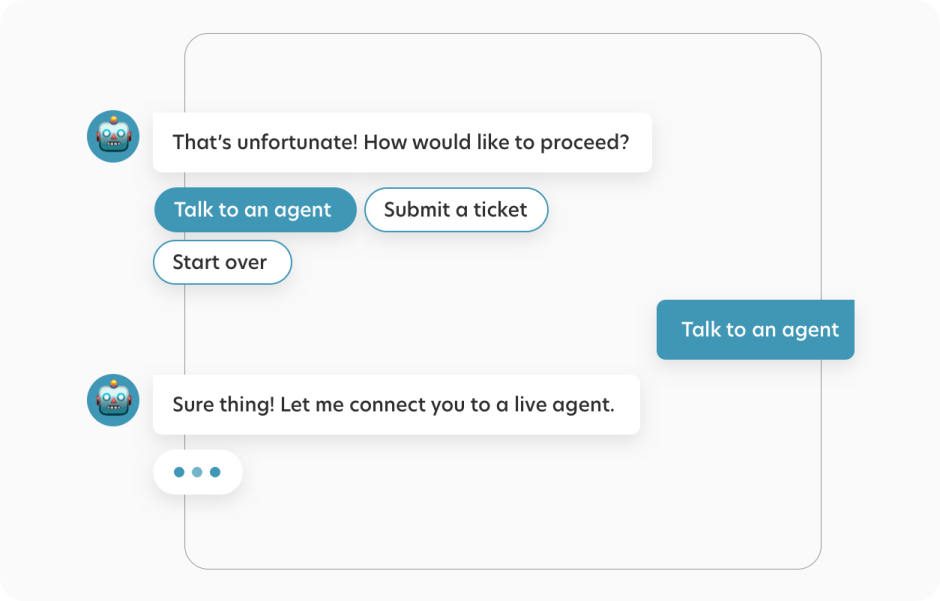
- Guides conversations with quick replies
- Delivers rich inline HTML content and KB articles
- Provides instant solutions to FAQs
- Enables customers to self-serve effectively
Seamless Help Desk Integration
- Integrates with HappyFox Help Desk and Zendesk Support
- Enables easy ticket creation when needed
- Maintains real-time communication sync
- Supports seamless agent handoffs
Intelligent Escalation
- Automatically escalates to available agents when needed
- Enables agent monitoring of bot conversations
- Allows agent barge-in capabilities
- Maintains conversation context during transfers
Performance Monitoring
- Provides detailed reports and analytics
- Measures bot performance metrics
- Optimizes conversation flows
- Tracks customer interaction success rates
Transform Your Support Today
AI bot training isn’t just about implementing technology – it’s about creating an intelligent support system that grows smarter with every interaction. Comprehensive suite like HappyFox provides the tools you need to build, train, and optimize your customer service bot effectively.
From natural language processing to intelligent response automation, you’ll have everything needed to streamline your customer service operations.
Ready to revolutionize your customer support? Schedule a HappyFox demo today and discover how our AI-powered solutions can transform your support operations.
AI Customer Service Bot – FAQs
Q1: What is an AI customer service bot?
A: An AI customer service bot is a sophisticated software program that uses artificial intelligence to handle customer inquiries, provide support, and resolve issues autonomously. Unlike basic chatbots that follow rigid scripts, AI-powered bots learn from interactions, understand context, and improve their responses over time. They can process natural language, access knowledge bases for accurate information, learn from successful interactions, and escalate complex issues to human agents when necessary.
Q2: Why can’t AI customer service bots be deployed as plug-and-play solutions?
A: AI customer service bots require strategic training to deliver value and aren’t ready to use immediately after installation. The effectiveness of your bot depends on the quality of its training data, the clarity of its objectives, and the consistency of its learning process. Without proper training using relevant data from your business, systematic objectives, and continuous improvement cycles, the bot cannot understand your customers’ specific needs or provide accurate, helpful responses.
Q3: What is the Data Clean-Up Strategy for training AI bots?
A: The Data Clean-Up Strategy involves systematically preparing and organizing your training data to ensure bot accuracy. This includes removing duplicate support articles and tickets, standardizing terminology across all materials, updating outdated information, and deleting conflicting resolutions. Clean, organized data helps the bot learn more effectively and provide consistent, accurate responses to customer inquiries.
Q4: What is the Top-20 Focus Method for bot training?
A: The Top-20 Focus Method concentrates initial training on your most common customer scenarios. Start by identifying your 20 most frequent customer queries, document successful resolution paths for each, create variation sets for different phrasings of the same question, and develop comprehensive response templates. This focused approach ensures your bot can handle the majority of customer interactions effectively from the start.
Q5: How does the Progressive Learning Framework work?
A: The Progressive Learning Framework structures bot training in increasing complexity levels to build capabilities systematically. Start with Level 1 covering basic information requests, progress to Level 2 for simple troubleshooting, advance to Level 3 for multi-step processes, and finally reach Level 4 for complex problem-solving. This gradual approach ensures the bot masters foundational skills before tackling more sophisticated customer service scenarios.
Q6: What is the Context-Builder Method?
A: The Context-Builder Method trains your bot to gather and use contextual information for more personalized support. This involves implementing customer history checks, creating product-specific question sets, building usage pattern recognition, and designing previous interaction analysis. By understanding context, the bot can provide more relevant, tailored responses that address each customer’s specific situation rather than generic answers.
Q7: How does the Response Matrix System improve bot performance?
A: The Response Matrix System creates comprehensive response frameworks for different customer scenarios. It structures responses by mapping customer intent to trigger phrases, response templates, follow-up actions, and escalation criteria. For example, account access issues trigger security verification, while billing queries prompt payment history review. This systematic approach ensures consistent, appropriate responses across all types of customer interactions.
Q8: Why is emotion recognition important for AI customer service bots?
A: Emotion recognition enables bots to identify and respond appropriately to customer emotions, creating more empathetic interactions. The Emotion Recognition Protocol involves creating emotion-specific response templates, defining clear escalation triggers for frustrated customers, including empathy phrases, and designing mood-appropriate follow-ups. This capability helps prevent customer frustration from escalating and ensures sensitive situations are handled with appropriate care.
Q9: What is the Knowledge Gap Detection System?
A: The Knowledge Gap Detection System systematically identifies and addresses areas where your bot lacks sufficient training. It tracks unanswered questions, monitors partial or incomplete responses, analyzes escalation patterns to human agents, and documents common points of customer confusion. By identifying these gaps, you can continuously improve your bot’s knowledge base and training to handle previously problematic queries.
Q10: How does the Feedback Loop Method contribute to bot improvement?
A: The Feedback Loop Method creates continuous improvement cycles for ongoing bot optimization. It implements immediate feedback collection from customers, tracks resolution success rates, monitors customer satisfaction scores, and adjusts responses based on performance data. This ongoing process ensures your bot continuously learns from real interactions and improves its effectiveness over time.
Q11: What features does HappyFox Chatbot offer for AI customer service?
A: HappyFox Chatbot provides comprehensive AI-powered capabilities including natural language processing that learns from every conversation, smart response management with quick replies and rich content delivery, seamless help desk integration with platforms like HappyFox and Zendesk, intelligent escalation to human agents when needed, and detailed performance monitoring with analytics. These features work together to create an effective, continuously improving customer support solution.
Q12: When should an AI bot escalate to human agents?
A: The Escalation Optimization Strategy defines when and how bots should escalate to human agents. Clear escalation triggers should be established, such as after multiple failed resolution attempts, when customers express strong emotion or frustration, for complex technical issues beyond bot capabilities, or when customers explicitly request human assistance. Effective escalation includes smooth handoff processes that maintain conversation context and ensure seamless transitions.