Ever spent hours updating your knowledge base, only to have customers complain they can’t find the information they need? You’re not alone.
According to a study by Microsoft, 77% of consumers say they favor brands that provide self-service support options. Yet, many companies struggle to maintain an up-to-date, easily navigable knowledge base that truly serves their customers’ needs.
This gap between customer expectations for self-service and the reality of most knowledge bases is where many support teams falter. Articles become outdated, search functions fall short, and suddenly, your knowledge base becomes a source of frustration rather than help.
But here’s the game-changer: AI-driven knowledge bases are bridging this gap, transforming static information repositories into dynamic, intelligent self-service powerhouses.
TL;DR
An AI knowledge base is a centralized hub that leverages AI and machine learning to transform how businesses manage information. Unlike static repositories, these systems allow teams to easily search internal databases and retrieve precise answers instantly. With advanced automation, you can use AI to generate articles in seconds and have AI generate a brief summary and automatically store it within your system. By implementing an intelligent knowledge base, organizations can scale their self-service capabilities, reduce agent workload, and ensure that both customers and employees have 24/7 access to accurate, real-time insights.
What Is An AI-Driven Knowledge Base?
An AI-driven knowledge base is an intelligent information system that uses machine learning (ML) and natural language processing (NLP) to organize, update, and retrieve data. Unlike traditional hubs, it understands user intent to deliver conversational, accurate answers across structured and unstructured content sourcesNow that we have learned what it is, let’s dive into how AI is revolutionizing knowledge bases and self-service capabilities, and how tools like HappyFox are at the forefront of this transformation.
The Manual Knowledge Base Challenge
Support teams face several hurdles when it comes to maintaining effective knowledge bases:
- Keeping content up-to-date with rapidly changing products and services
- Ensuring information is easily discoverable by users
- Tailoring content to different user groups and their specific needs
- Measuring the effectiveness of knowledge base articles
- Identifying gaps in existing documentation
Traditional knowledge base systems often struggle with these challenges. But AI? It thrives on turning these challenges into opportunities for enhanced self-service support.
How AI Transforms Knowledge Bases and Self-Service
Intelligent Content Creation and Updates
AI analyzes support tickets and user behavior to automatically generate and update knowledge base articles, ensuring content remains relevant and timely.
Enhanced Search Capabilities
AI-powered search understands user intent, not just keywords, delivering more accurate and helpful results to user queries.
Personalized Content Recommendations
By analyzing user data and behavior, AI can suggest the most relevant knowledge base articles for each user’s specific situation.
Continuous Content Optimization
AI constantly evaluates the performance of knowledge base articles, suggesting improvements and identifying underperforming content.
Automated Gap Analysis
AI identifies topics that are frequently searched for but not well-covered in the existing knowledge base, highlighting areas for new content creation.
Leveraging these AI capabilities, businesses can transform their knowledge bases from static repositories into dynamic, intelligent self-service platforms.
Implementing AI-Driven Knowledge Bases: A Step-by-Step Guide
1. Assess Your Current Knowledge Base
- Identify pain points in your existing self-service offerings
- Analyze user feedback and usage metrics of your current knowledge base
2. Choose the Right AI Tools
- Consider HappyFox’s comprehensive AI suite for knowledge base enhancement
- Ensure the solution integrates with your existing support systems and content management platforms
3. Prepare Your Data
- Gather historical support data and existing knowledge base content for AI training
- Organize your current articles and categorize them effectively
4. Train Your Team
- Introduce AI tools gradually, starting with content creation and optimization
- Emphasize how AI enhances the team’s ability to provide more effective self-service resources
5. Start Small and Scale
- Begin with AI Knowledge for automating article updates and gap identification
- Gradually introduce additional AI tools as your team adapts and user needs evolve
6. Monitor and Optimize
- Use HappyFox’s analytics to track AI performance in enhancing self-service effectiveness
- Continuously refine AI-generated content based on user feedback and usage patterns
HappyFox AI: Powering Next-Generation AI Driven Knowledge Bases

HappyFox offers a suite of AI-powered tools designed to enhance knowledge bases and self-service capabilities:
1. AI Knowledge
- Identifies gaps in existing documentation, ensuring comprehensive coverage of user needs.
- Automatically recommends knowledge base articles based on support ticket patterns
- Evaluates and improves content effectiveness, enhancing self-service success rates
- Keeps self-service resources current, reducing the burden on support teams

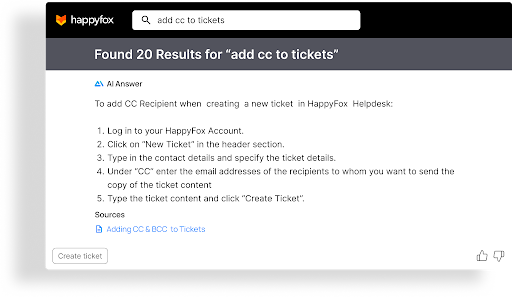
2. AI Answers
- Provides instant, AI-generated answers to user queries directly in the support center
- Leverages the knowledge base to offer accurate, context-aware responses
- Learns from user interactions to continuously improve response quality
- Ideal for addressing common questions, reducing ticket volume and enhancing self-service.
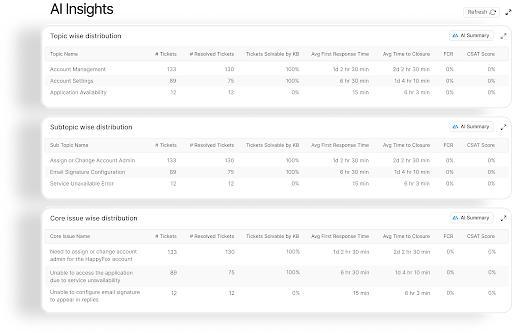
3. AI Insights
- Analyzes user interaction data with the knowledge base to identify trends and improvement opportunities
- Recommends optimizations to knowledge base structure and content based on user behavior
- Provides actionable insights on self-service effectiveness and user satisfaction
- Helps identify high-impact areas for knowledge base expansion and refinement
4. AI Copilot
- Assists support agents in finding relevant knowledge base articles
- Suggests relevant content additions based on recent support interactions
- Streamlines the process of translating complex support solutions into user-friendly documentation
By leveraging these AI-powered tools, businesses can create knowledge bases that not only meet but exceed user expectations for self-service support
Conclusion: Embrace AI for Unparalleled Self-Service Support
An effective knowledge base isn’t just a nice-to-have – it’s a critical component of customer satisfaction and operational efficiency. AI-driven knowledge bases aren’t just tools; they’re strategies for turning your self-service offerings into a competitive advantage.
By implementing AI tools like those offered by HappyFox, you’re not just improving your knowledge base; you’re building a self-service powerhouse that can significantly reduce ticket volume while enhancing user satisfaction.
Schedule a demo with us to see how we bring things into action!
FAQ
What are AI knowledge bases?
An AI knowledge base is a smart, self-evolving repository that uses Machine Learning (ML) and NLP to manage information. Unlike static databases, it understands the context and intent behind user queries, enabling it to pull accurate answers from vast amounts of data and deliver them in a conversational format.
Which AI tool is best for knowledge?
The best tool depends on your integration needs, but HappyFox AI is a leader for teams seeking seamless self-service. By using features like AI Answers and AI Copilot, it transforms raw documentation into a powerful engine that assists both customers and agents with high-precision, real-time responses.
What is an example of a knowledge base in AI?
A primary example is an AI-powered Help Center. When a customer asks a complex question, the AI doesn’t just provide a list of links; it scans articles, understands the specific problem, and generates a direct, concise answer similar to how HappyFox Assist AI operates within Slack or Microsoft Teams.