What is ROI in Help Desk Software?
ROI (Return on Investment) in a help desk evaluates the financial and operational value generated compared to the cost of running support. It measures improvements in cost per ticket, resolution efficiency, employee productivity, customer satisfaction and retention to determine overall business impact. It also includes improvements in operational metrics such as:-
- Faster ticket resolution times
-
- Better resource allocation
-
- Enhanced customer experiences
-
- Higher agent satisfaction
Key Metrics for Measuring ROI
1. Resolution Time Optimization
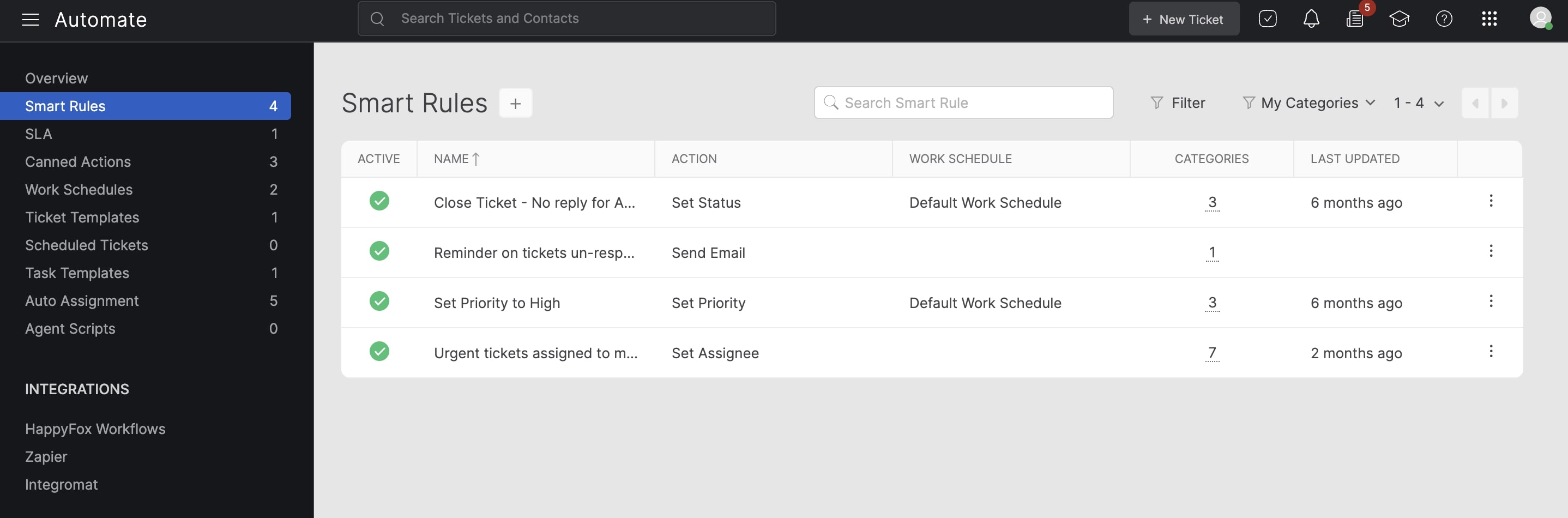
Quick ticket resolution directly impacts customer satisfaction and operational costs. Modern automation capabilities, like HappyFox’s Smart Rules, streamline routine processes by automatically routing tickets based on complexity, urgency, and agent expertise. This intelligent workflow automation ensures that issues reach the right agent immediately, significantly reducing resolution times. For instance, when a high-priority ticket arrives, Smart Rules can automatically:- Assign it to agents with relevant expertise
- Set appropriate SLA timers
- Trigger necessary notifications
- Update ticket status and priority
2. First-Contact Resolution (FCR) Enhancement
Improving FCR rates requires equipping agents with the right tools and information. This is where AI-powered support solutions make a significant difference. HappyFox’s AI Agent Copilot assists agents by- Suggesting relevant knowledge base articles during ticket resolution
- Providing intelligent response recommendations
- Assist agents with crafting, editing and translating responses
3. Agent Productivity Optimization
Support teams often struggle with repetitive tasks that consume valuable time. Automation and AI can transform this landscape. For example, HappyFox’s automation suite handles routine tasks like:
- Automated Ticket categorization and routing
- Automated Status updates and notifications
- Automated SLA tracking and alerts
- Canned responses for repetitive queries
- AI-generated answers for instant responses

4. Customer Satisfaction Impact
CSAT scores directly correlate with customer retention and lifetime value. Modern help desk solutions enhance satisfaction through:
-
- Faster response times
-
- Better self-service options
-
- More accurate resolutions
-
- Consistent support experiences
-
- Proactive issue resolution
How to Calculate ROI for Help Desk Software
Here’s a straightforward way to calculate ROI: ROI (%) = [(Benefits – Cost) / Cost] x 100 Example Calculation: Cost of Software: $12,000/year Benefits:-
- Reduced manual routing time: $15,000
-
- Automated response handling: $12,000
-
- Streamlined workflow processes: $10,000
-
- Improved first-contact resolution: $18,000
-
- Reduced ticket volume through AI deflection: $14,000
-
- Enhanced knowledge management: $8,000
-
- Productivity Gains
-
- Increased agent efficiency: $16,000
-
- Better resource utilization: $10,000
Steps to Evaluate Help Desk ROI Before Buying
Step 1: Calculate Cost Per Ticket
Divide total annual support costs including salaries, tools, overhead, and management time by total ticket volume. This establishes your financial baseline. If your cost per ticket is unknown, ROI projections will be unreliable.Step 2: Track Ticket Volume and Tier Shift
Analyze ticket distribution across Tier 1, Tier 2, and higher levels. A high percentage of repetitive Tier 1 tickets indicates automation opportunity. Shifting volume downward reduces handling cost and improves scalability.Step 3: Implement Self Service
Evaluate how many tickets could be resolved through knowledge base articles, FAQs, or AI driven assistance. Increasing self service reduces incoming ticket volume and directly lowers operational expense.Step 4: Automate Processes
Identify repetitive workflows such as routing, categorization, SLA tracking, and status updates. Automation reduces manual effort and average handle time. Over thousands of tickets, small time savings create meaningful financial return.Maximizing ROI with HappyFox
HappyFox Help Desk is designed to maximize your ROI by delivering measurable improvements across all key areas of your support operations:-
- AI-Powered Ticket Management: Reduce manual intervention and speed up resolutions with intelligent ticket routing, automated categorization, and AI-assisted responses.
-
- Omnichannel Help Desk: Minimize the back-and-forth between tools by consolidating data in one place, enabling seamless omnichannel support across email, chat, phone, and social media.
-
- Customizable Automation Rules: Tailor workflows to fit your organization’s unique needs with Smart Rules that automate ticket assignments, updating ticket properties, and notifications.
-
- Knowledge Management Integration: Boost self-service efficiency with AI-powered article suggestions and automated knowledge base creation, reducing ticket volume and support costs.
-
- Multi-Brand Support Architecture: Scale operations efficiently by managing multiple brands from a single platform, with customized portals, workflows, and knowledge bases for each brand.
-
- Advanced Analytics Suite: Drive continuous improvement through comprehensive reporting tools that track KPIs, analyze trends, and provide actionable insights into support operations.
The Hidden ROI of Help Desk Software
1. Improved Team Morale When agents don’t have to deal with repetitive, frustrating tasks, their overall satisfaction improves. This leads to lower turnover and better performance. 2. Scalability for Growth As your organization grows, so do ticket volumes. HappyFox’s robust architecture and automation capabilities ensure your help desk scales seamlessly, without adding unnecessary costs or delays. 3. Better Operational Insights HappyFox’s reporting and analytics tools allow you to identify inefficiencies, track performance, and make informed decisions, driving consistent improvement in service delivery.Is Your Help Desk Software Delivering Value?
Ask yourself these questions:-
- Have resolution times improved since implementation?
-
- Are your agents spending more time on valuable tasks?
-
- Are customers reporting better service experiences?
Conclusion: The ROI Is in the Details
Measuring help desk ROI goes beyond simple cost comparison. It requires understanding how efficiency gains, faster resolution, and improved service quality translate into measurable business value. The real impact shows when operational improvements support both performance and long term growth. Ready to see how HappyFox can transform your customer support experience? Schedule a demo today.