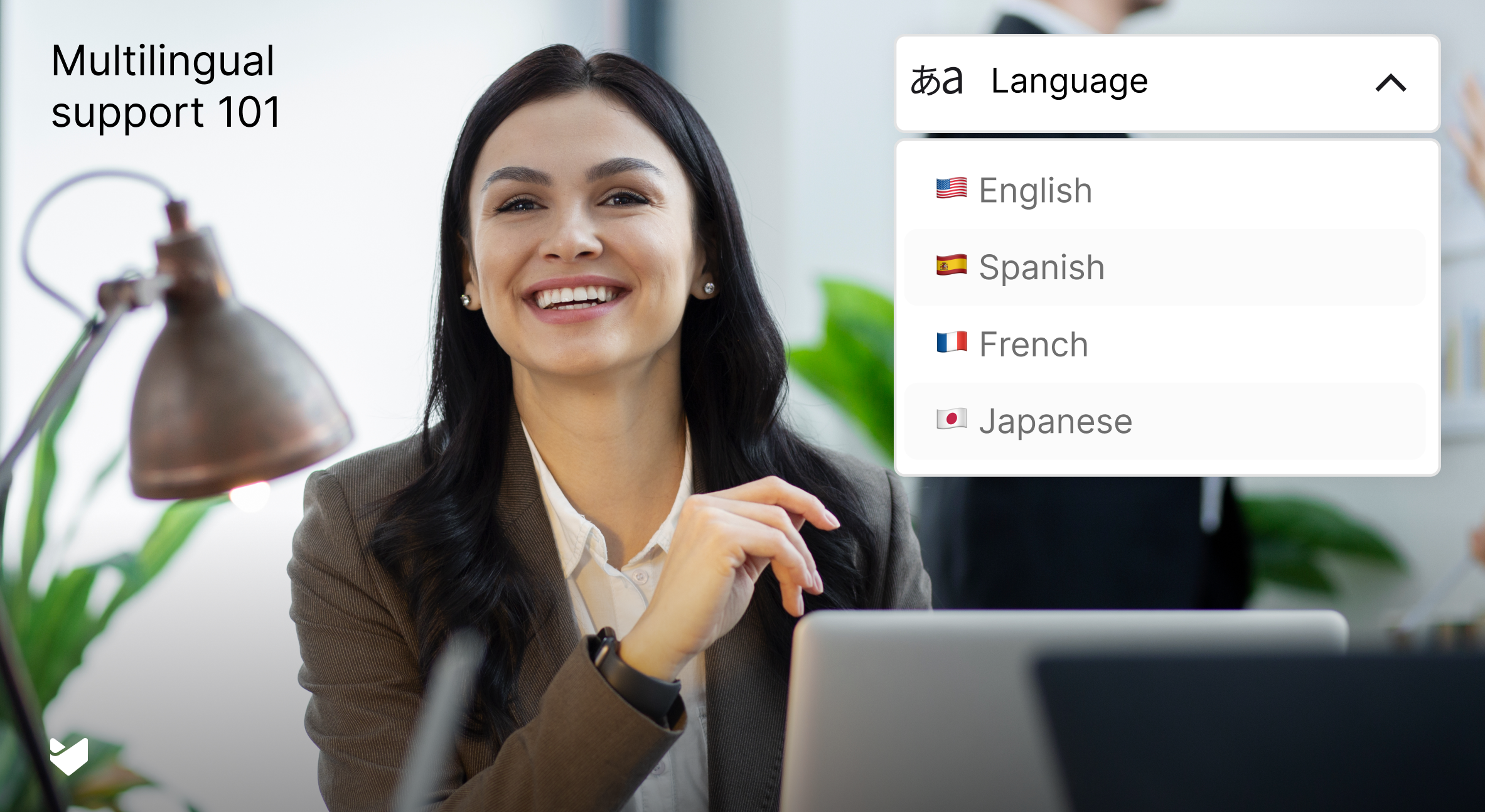
Multilingual customer support has become a core capability for any business serving customers across borders. When a customer reaches out for help in Spanish, German, or Japanese, the speed and quality of the response shape their next move. A slow or off-tone reply pushes them toward a competitor that speaks their language.
This guide is written for CX teams scaling support globally. It covers what multilingual customer support looks like today and the delivery models teams choose between.
It also explains the operational layers that decide whether those models actually work in practice.
TL;DR
- Multilingual customer support helps CX teams deliver consistent service across languages by combining native agents, AI translation, localized self-service, and skills-based routing.
- Every top guide frames this as a staffing choice. The operational architecture underneath is the bigger lever.
- Five delivery models cover most operations: native agents, outsourced BPOs, real-time AI translation, multilingual chatbots, and hybrid.
- Skills-based routing, versioned KBs, localized macros, and per-language CSAT decide whether any staffing model works.
- A tiered language rollout using core, growth, and test tiers beats launching every language at once.
- Reporting CSAT as a global average hides per-language collapses, so measure separately from day one.
What is multilingual customer support?
Multilingual customer support is the practice of assisting customers in their preferred language across every channel a business offers, from chat and email to voice and self-service.
The intent is quality parity, not just coverage. A German customer resolving a billing issue in German should reach the same outcome, in the same time, with the same clarity as an English customer with the identical issue. Every layer of the support stack, from the initial ticket route to the closing macro, either supports that parity or quietly breaks it.
Multilingual vs. localized vs. multi-region support
These three terms overlap and get used interchangeably, which causes planning mistakes.
- Multilingual covers the language layer: agents, macros, and KB content available in more than one language.
- Localized goes further into cultural fit: idiom, tone, currency, formatting, and regional compliance.
- Multi-region is operational: data residency, follow-the-sun shift coverage, and regional data protection rules.
A support operation can be multilingual without being fully localized. Deciding which of the three the team is actually solving for changes the budget conversation.
Why do multilingual support programs underperform even when the staffing is right?
Programs underperform when staffing is treated as the whole solution. Routing, KB coverage, macro localization, and per-language measurement decide whether native-speaker skill ever reaches the right ticket.
Routing gaps
Tickets land in generic queues. Non-English tickets get picked up by whoever is available. Even with 20 Spanish-fluent agents on the floor, if the routing rule cannot detect language on arrival, the ticket goes to a random agent. The staffing investment silently produces a random-agent experience.
Knowledge base drift
Teams translate 200 help articles once at launch, then update the English source 40 times over the next year and never touch the translations. Deflection rate in that language quietly collapses. Customers stop trusting the KB, ticket volume rises, and the fix looks like “hire more agents.”
Metric blur when CSAT is reported as an average
A support org reporting 87% CSAT can hide a Portuguese CSAT of 62% and a French CSAT of 91%. Aggregation protects the executive dashboard and punishes the customer. Nobody on the floor gets a signal that a language is failing until churn appears in the revenue report a quarter later.
Macro and canned response gaps
Agents use canned responses to hit SLA. If the macro library exists only in English, non-English agents write every reply from scratch. Handle time in that language grows by 30% to 50%, and reply consistency drops with it.
Pro Tip: Before hiring native agents for a new language, audit whether your existing routing, KB, and macro layers even recognize that language. Adding fluent people to a stack that cannot deliver their work is the most expensive mistake in this space.
What are the main delivery models for multilingual customer support?
Five delivery models cover most operations: native language agents, outsourced BPOs, real-time AI translation, multilingual chatbots, and hybrid combining AI with human escalation.
| Model | How it works | Best for | Trade-offs |
| Native Language Agents | Fluent staff assigned to language-specific queues | Core languages with high ticket volume | Highest quality, highest fixed cost |
| Outsourced BPOs | Third-party provider staffs multilingual agents | Growth languages with moderate volume | Fast to scale, less brand control |
| Real-Time AI Translation | Software translates between customer and English-speaking agent | Test-tier languages with low volume | Fast, quality varies by language pair |
| Multilingual Chatbots | Conversational AI trained in multiple languages handles Tier 1 queries | Deflectable, repetitive queries | Great at volume, weak at empathy |
| Hybrid (AI plus Human) | AI handles first response, escalates to a native or bilingual agent | Most mid-market and enterprise ops | Requires careful escalation thresholds |
Native language agents
How it works: Full-time or contract agents assigned to language-specific queues.
Best for: Core languages representing the majority of ticket volume.
Trade-offs: Highest quality, highest fixed cost per language covered.
When to consider: A market crosses a volume threshold where in-house staffing is cheaper than translation plus escalation.
Outsourced BPOs
How it works: A third-party contact center staffs and manages agents in specific languages under an SLA.
Best for: Growth languages where volume justifies coverage but not a full internal team.
Trade-offs: Fast to scale across many languages, but brand voice, QA, and consistency depend on partner rigor.
When to consider: Coverage across three or more new languages is needed inside a 90-day window.
Real-time AI translation
How it works: Software translates the customer’s message into English before it reaches an agent, then translates the reply back into the customer’s language. Real-time chat translation tools sit inside the chat widget itself.
Best for: Test-tier languages where volume is low and hiring is premature.
Trade-offs: Quality varies by language pair. Idioms, technical terms, and negations drop first.
When to consider: A new market is being validated and volume is still below 100 tickets per month per language.
Multilingual chatbots
How it works: Conversational AI trained across languages handles Tier 1 queries: order status, resets, FAQ deflection, appointment changes. Handoff to a human agent is automatic when the bot’s confidence drops or the topic escalates.
Best for: High-volume repetitive tickets across multiple languages, backed by a well-structured self-service portal.
Trade-offs: Poor at nuance, escalation-heavy topics, or empathy-sensitive cases.
When to consider: Deflection is a formal KPI and the KB is already reasonably mature.
Hybrid (AI plus human)
How it works: AI takes the first response, then routes by confidence score, sentiment, or ticket category to a bilingual or native agent.
Best for: Mid-market and enterprise ops handling five or more languages.
Trade-offs: Requires clear escalation thresholds and separate QA on the AI leg.
When to consider: Ticket volume growth outpaces hiring capacity in one or more markets.
How do you choose the right multilingual support model for your team?
Sort languages into three tiers by ticket volume and market strategic value, then match each tier to the delivery model that fits its economics.
The Three-Tier Language Framework
Core tier
Languages that carry more than 20% of ticket volume or serve strategically critical markets. Staff with native agents and treat these as a full support product with dedicated KB coverage, macro packs, and per-language QA.
Growth tier
Languages representing 5% to 20% of volume, or markets earmarked for the next 12 months. Cover with BPO partners, hybrid AI plus human workflows, or a mix. Invest in localized macros and KB translation, but stop short of full-time native headcount.
Test tier
Languages below 5% of volume, or new markets still being validated. Real-time AI translation and multilingual self-service carry these without a hiring commitment. Move a language up to Growth only after volume and CSAT stability justify the spend.
Worked example: An ecommerce operation with 40,000 monthly tickets sees 62% English, 18% Spanish, 9% German, 6% French, 3% Portuguese, 2% Italian. English and Spanish are Core, German and French are Growth, Portuguese and Italian are Test. Model assignment now follows from the tier, not from opinion.
What operational layers determine whether any multilingual model actually works?
Four layers sit under every staffing choice: language-based routing, versioned multilingual KB, localized macros, and per-language QA. Neglect any one and even native agents cannot save the program.
Consider a Spanish-speaking customer submitting a ticket. Two paths.
Path A, broken routing: Ticket lands in a general queue. An English-only agent picks it up, spends three minutes translating with a browser extension, replies in stiff Spanish, receives a clarifying reply, and escalates to a bilingual peer. Handle time reaches 12 minutes. CSAT is unpredictable.
Path B, working routing: Ticket is language-tagged on arrival and routed to the Spanish queue. A native agent picks it up, replies using a localized macro, and closes in one exchange. Handle time is 4 minutes. CSAT is predictable.
Path A costs roughly three times the handle time and produces an unpredictable CSAT signal. That is a routing failure, not a staffing failure. The same team, the same agents, and the same tickets produce different outcomes based only on the infrastructure underneath.
Skills-based language routing rules
Detect language from the ticket source, customer profile, or message body. Route to queues tagged with matching language skills. Fall back to hybrid AI or bilingual queues only when the native queue hits capacity. A working chat routing and queueing setup makes this a rule, not an ad-hoc handoff.
Multilingual knowledge base versioning
Every English article gets a translation counterpart with a “last synced” timestamp. When the English version updates, the translation flag turns yellow for review. Deflection reports track KB usage per language, not overall. A properly built multilingual knowledge base treats translations as first-class content, not as a one-time export.
Macro and canned response localization
Every macro used by more than 10% of agents in the English pack gets translated for every core and growth language. Macros are versioned alongside the KB, refreshed quarterly, and audited against the current English source. This is the single fastest lever for handle-time parity across languages.
Per-language QA and translation drift audits
Sample 10 tickets per language per week for native-speaker QA. Score for accuracy, tone, and cultural fit. Flag AI-translated tickets below a confidence threshold for review. Audit KB translations quarterly against the current English source to catch drift before customers do.
Pro Tip: Language routing is worth building even if only one bilingual agent is on the team. It converts an ad-hoc handoff into a repeatable rule, and the moment the second bilingual hire lands, the infrastructure is already in place.
What does a well-run multilingual support operation look like?
Observable signals include first-response time parity across core languages, CSAT variance under 5 points, KB coverage above 80% per language, and quarterly macro refreshes across every tier.
Concrete signals to look for:
- First-response time per language sits within 20% of the English baseline
- CSAT variance across top five languages stays under 5 points
- Multilingual KB coverage exceeds 80% of the English article count for every core language
- Macro packs refresh at least quarterly for every core and growth language
- Native-speaker QA samples run weekly for every core language
- Ticket routing tags language on arrival for more than 95% of non-English tickets
- Deflection rate reports per language, not as a global aggregate
What are the common pitfalls in multilingual customer support?
Pitfalls repeat across teams: launching too many languages at once, treating translation as a one-time project, and reporting CSAT as an average that hides per-language collapses.
Pitfall 1: Launching every language at once
Symptom: Every language performs mediocrely.
Cause: No tiering, no prioritization, resources stretched across too many markets.
Fix: Apply the Three-Tier framework. Launch Core first, prove the model, then add Growth.
Pitfall 2: One-and-done KB translation
Symptom: Deflection rate collapses in non-English languages three months after launch.
Cause: English KB updated continuously, translations frozen at launch.
Fix: Sync flag every article. Assign a KB owner per language who reviews on every English update.
Pitfall 3: CSAT reported as a global average
Symptom: Executive dashboard shows healthy CSAT while individual language markets churn.
Cause: Aggregation hides variance.
Fix: Split CSAT reporting by language. Alert on any language dropping more than 5 points from the English baseline.
Pitfall 4: Skipping macro localization
Symptom: Non-English agents run handle times 30% to 50% higher than the English team.
Cause: Every reply written from scratch, no localized macro pack.
Fix: Translate the top 20 macros for every core and growth language. Refresh quarterly.
Pitfall 5: Trusting AI translation without QA
Symptom: Ticket resolution looks fine on the surface, then a spike in escalations or negative CSAT reveals systematic mistranslation.
Cause: AI translation output shipped without native-speaker sampling.
Fix: Weekly QA sample per language. Confidence-score gating on AI-translated replies before they reach the customer.
How do you measure the ROI of multilingual customer support?
Measure per language, not in aggregate. Track CSAT, first-response time, resolution time, deflection rate, and cost per contact separately for every core and growth language.
| Metric | What it tells you | How to segment |
| CSAT per language | Whether service quality holds across languages | Split by top five to eight languages, alert on variance over 5 points |
| First-response time per language | Whether routing and staffing align with volume | Compare each language to the English baseline |
| Resolution time per language | Whether KB and macro coverage is working | Segment by ticket type within each language |
| Deflection rate per language | Whether self-service and chatbots earn their cost | Track KB and bot resolutions per language |
| Cost per contact per language | Whether the delivery model matches the economics | Compare native, BPO, AI, and hybrid channels |
Global aggregates are still useful for board reporting. Operational decisions need the per-language view, backed by segmented satisfaction survey reporting and a broader set of customer service metrics.
Where do CX teams go from here?
Staffing is the visible part of multilingual customer support. Routing rules, KB versioning, macro localization, and per-language measurement decide whether staffing ever pays back.
Three things carry the outcome:
- Tier every language into core, growth, or test before staffing decisions get made
- Build routing, KB versioning, and macro localization as first-class infrastructure, not as afterthoughts
- Measure per language from day one, and alert on variance instead of averages
For CX teams evaluating dedicated tooling, multilingual help desk software with language routing, KB versioning, and localized macros is the shortest path from these principles to a working operation.
Frequently Asked Questions
What is multilingual customer support?
Delivering assistance in a customer’s preferred language across chat, email, phone, and self-service to keep quality consistent globally.
How many languages should you start supporting first?
Start with languages covering 80% of ticket volume, then expand by market value using a core, growth, and test tier model.
Which delivery model is best: in-house, outsourced, or AI translation?
Match model to language tier. Native agents for core, AI translation for test, hybrid or BPO for growth languages.
How do you measure CSAT across different languages?
Track CSAT, first-response, and resolution time separately per language. Global averages hide per-language collapses.
How do you ensure translation quality in customer support?
Run weekly native-speaker QA samples, audit KB articles quarterly for drift, and flag AI translations below confidence.
What is a hybrid AI plus human multilingual support model?
Route tickets to AI translation first, then escalate to a native or bilingual agent when confidence or complexity crosses a threshold.
What channels matter most for multilingual customer support?
Prioritize self-service and chat for scale, add email for complex cases, and layer voice only where volume justifies native agents.