The terms get used interchangeably. They should not be. A chatbot and a virtual assistant are built on different assumptions, serve different purposes, and produce very different outcomes depending on how and where you deploy them. Getting the distinction wrong means either over-engineering a simple problem or under-equipping a complex one.
This guide cuts through the noise. You will find clear definitions of both, a practical breakdown of how they differ across ten dimensions, a comparison table for fast reference, and a decision framework for choosing the right one for your situation. The brief also covers how chatbots and virtual assistants work individually and how they work better together.
TL;DR
Chatbots handle specific, bounded tasks: answering FAQs, routing support tickets, qualifying leads, and deflecting repetitive queries. Virtual assistants operate at a broader level, managing multi-step workflows, learning from context, and responding across voice and text. The key difference is not just intelligence but scope. Chatbots are purpose-built tools. Virtual assistants are adaptive platforms. Most businesses need one, some need both, and the right call depends on your use case, your users, and how much workflow complexity you are actually dealing with.
What Is A Chatbot?
A chatbot is a software program designed to simulate conversation and handle a defined set of tasks through text-based interaction. At the simpler end, chatbots follow decision trees: the user selects from options or enters keywords, and the bot responds with a pre-set answer. At the more sophisticated end, AI-powered chatbots use natural language processing to interpret intent and generate contextually relevant responses.
The defining characteristic is scope. A chatbot is built for a specific domain and a specific set of interactions. A customer support chatbot handles support queries. A lead qualification chatbot handles lead qualification. It does not cross between domains, and it does not remember context between separate sessions unless it is specifically engineered to do so. That bounded nature is both its strength and its limitation: it does exactly what it is configured to do, reliably, at scale, without the overhead of a more complex system.

What Is A Virtual Assistant?
A virtual assistant is an AI-powered system designed to handle a broad range of tasks across multiple domains, often through both voice and text interaction. Where a chatbot is purpose-built, a virtual assistant is adaptive. It learns from context, remembers prior interactions, and can execute multi-step workflows that span different tools and systems.
The intelligence level is meaningfully different. A virtual assistant uses machine learning to improve over time, natural language understanding to interpret nuanced requests, and integration layers to take action across connected platforms. When you ask a virtual assistant to schedule a meeting, find a document, summarize an email thread, and draft a reply, it is not retrieving pre-set answers. It is reasoning across context and executing a sequence of connected tasks.
Key Differences Between Chatbots and AI Virtual Assistants
The surface-level difference is intelligence. The more useful distinction is purpose. A chatbot is optimized for volume and repeatability within a narrow domain. A virtual assistant is optimized for flexibility and depth across a wide one. Neither is superior in the abstract. The right tool is the one matched to what the task actually demands.
Scope is the clearest dividing line. Chatbots are single-purpose: they handle one category of interaction and handle it well. Virtual assistants are multi-domain: they move between tasks, carry context forward, and adapt to the individual user over time. From there, the differences cascade through technology, interaction model, and appropriate use case.
- Learning: chatbots are static unless manually updated; virtual assistants learn and refine their responses based on usage patterns over time.
- Intelligence: chatbots operate on rules or basic NLP; virtual assistants use machine learning and contextual memory that develops with use.
- Interaction model: chatbots are reactive, they respond to what is asked; virtual assistants can initiate, follow up, and complete tasks proactively.
- Channels: chatbots live primarily in text-based interfaces; virtual assistants operate across voice and text, often across multiple platforms simultaneously.
- Complexity: chatbots handle low-to-medium complexity tasks predictably; virtual assistants manage multi-step workflows where variables change between sessions.
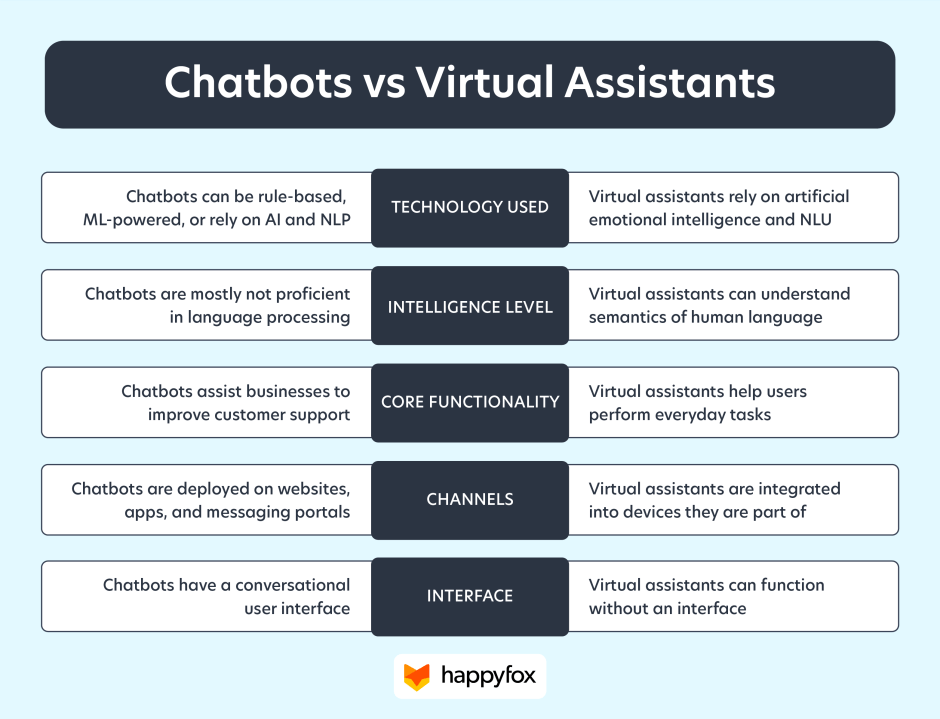
Comparison Table: Chatbot vs Virtual Assistant
A side-by-side view across the ten dimensions that matter most in a deployment decision.
| Metric | Chatbot | Virtual assistant |
| Scope | Narrow, single task or domain | Broad, multiple tasks and contexts |
| Intelligence Level | Rule-based or basic NLP | Advanced AI, learns over time |
| Core Functionality | Answer FAQs, route tickets, qualify leads | Schedule, research, execute multi-step tasks |
| Technology Used | Decision trees, NLP, keyword matching | NLP, ML, contextual memory, integrations |
| Channels | Website, app, messaging platforms | Voice, text, email, cross-platform |
| Interface | Text-based chat window | Voice and text, adaptive UI |
| Interaction Type | Reactive, responds to prompts | Proactive and reactive |
| Use Case | Customer support, lead capture, self-service | Productivity, research, complex workflows |
| Complexity | Ranges from simple to moderately complex | Generally more complex |
| Examples | Website support bots, chat widgets | Siri, Google Assistant, Alexa |
How Chatbots and Virtual Assistants Are Used Across Industries
The same underlying technology looks very different depending on the industry it is deployed in. Across sectors, the pattern holds: chatbots absorb the volume, virtual assistants manage the complexity. What changes is what volume and complexity actually mean in that context.
E-Commerce
Chatbots handle the bulk of post-purchase interactions: order status, return windows, refund timelines, and product availability queries. They sit on product pages, cart pages, and support portals, deflecting the repetitive queries that would otherwise fill agent queues. Virtual assistants come into play for higher-value interactions, personalized product recommendations based on browsing and purchase history, proactive outreach to high-value customers, and cross-platform coordination between inventory, CRM, and fulfilment systems.
Healthcare
In healthcare, chatbots manage appointment booking, symptom triage, prescription refill requests, and insurance FAQ handling without requiring clinical staff involvement. The use case is bounded by design: healthcare organizations cannot afford ambiguity at the intake layer. Virtual assistants operate in the administrative layer, helping clinical teams manage schedules, surface patient history ahead of consultations, and coordinate between departments on complex cases that involve multiple specialists.
Travel and Hospitality
Chatbots handle the high-frequency touchpoints: booking confirmations, itinerary lookups, cancellation policies, and check-in instructions. For a hotel group or airline managing thousands of daily customer contacts, automating these interactions at the chatbot layer is the only way to maintain response times without scaling headcount linearly. Virtual assistants add value in the concierge layer, handling personalized requests, managing loyalty program interactions, and coordinating multi-leg trip changes that require cross-system access and contextual judgment.
Finance
Banks and financial services firms use chatbots for account balance queries, transaction history, fraud alert acknowledgements, and basic product information. The interactions are well-defined and high-volume, exactly the conditions where a chatbot outperforms a human agent on speed and consistency. Virtual assistants are deployed deeper in the stack for wealth management clients, financial advisors, and internal compliance teams who need to surface documents, cross-reference regulations, and prepare client-facing summaries quickly.
IT and Internal Support
This is where HappyFox operates most naturally. IT support teams use chatbots to handle first-line employee requests: password resets, access provisioning, software installation guides, and common troubleshooting flows. The chatbot deflects the tier-one load so agents handle only what genuinely requires human judgment. Virtual assistants extend this further into cross-department workflows, helping IT leads manage incident escalations, track SLA compliance across teams, and coordinate with HR and Facilities on onboarding tasks that span multiple systems.
Chatbots and Virtual Assistants: How They Work Together
The most effective deployments do not treat chatbots vs virtual assistants as a binary choice. They use each tool for what it is genuinely suited for, then connect them. A chatbot handles the front-line volume: FAQs, ticket creation, basic triage, lead qualification. The virtual assistant operates further back in the workflow, managing escalations, coordinating between departments, and executing the multi-step tasks that require context the chatbot never had.
In a customer support context, this looks like a chatbot managing first contact and handling the majority of tier-one queries. Complex or high-priority issues that require judgment, cross-system data, or a human handoff get passed to the virtual assistant layer, which has the context and capability to manage the next step. The result is higher overall resolution rates without the cost of routing everything through a more powerful, more expensive system.
Which One Should You Choose: Chatbot or Virtual Assistant?
Start with the problem, not the technology. If you have a high volume of repetitive, predictable queries in a single domain, a chatbot is the right call. It is faster to deploy, easier to maintain, and purpose-built for exactly that scenario. If you need something that operates across functions, learns from individual usage patterns, and handles tasks that require reasoning across multiple systems, a virtual assistant is the better fit.
Budget and timeline also matter. A well-configured chatbot can be live in days. A virtual assistant implementation that genuinely reflects an organization’s workflow complexity typically takes weeks to months. Neither is a shortcut for the other. Trying to make a chatbot do a virtual assistant’s job produces a brittle, frustrating experience. Deploying a virtual assistant for work a chatbot could handle is simply over-engineering.
- Choose a chatbot if: your use case is bounded, high-volume, and repetitive. Customer support deflection, lead qualification, FAQ handling, appointment booking.
- Choose a virtual assistant if: your use case spans multiple tools, requires contextual memory, or involves multi-step tasks that change based on prior interactions.
- Consider both if: you need front-line automation at scale and a deeper layer for complex resolution, coordination, or executive productivity.
Benefits of Chatbots
Chatbots deliver the most immediate, measurable ROI of any automation tool in the support and marketing stack. The gains show up in three areas: volume handling, availability, and lead conversion.
- 24/7 availability: chatbots do not have shifts. A query that arrives at 2am gets the same response as one that arrives at 2pm. For global operations, that consistency is not optional.
- Instant response at scale: a single chatbot handles hundreds of simultaneous conversations. No queue, no wait time, no degradation in response quality as volume spikes.
- Consistent messaging: every user gets the same accurate answer, every time. Human agents drift; well-configured chatbots do not.
- Lead qualification without agent time: chatbots ask the right questions, score the lead, and route high-intent visitors to sales while everyone else enters a nurture track.
- Lower cost per interaction: automation absorbs the routine load, which means human agents spend their time on work that actually requires judgment.
How Chatbots Work
The mechanics depend on the type of chatbot, but all of them follow the same fundamental loop: receive input, interpret it, match it to a response, deliver that response, and wait for the next input.
Rule-based chatbots use decision trees. The user’s input is matched against a set of defined keywords or options, and the corresponding response is returned. There is no inference, no learning, and no ability to handle inputs outside the defined ruleset. They are reliable within their limits and break visibly when those limits are reached.
AI-powered chatbots use natural language processing to interpret intent rather than match keywords. The input is parsed, the intent is classified, entities are extracted, and a response is generated or retrieved based on the interpreted meaning. More advanced implementations use machine learning to improve intent classification over time based on prior conversations. The result is a chatbot that handles a wider range of phrasings for the same underlying request and gets better the more it is used.
Benefits of Virtual Assistants
Virtual assistants deliver value primarily through complexity reduction and personalization. They absorb the coordination overhead that currently sits with humans: scheduling, information retrieval, follow-up management, cross-platform task execution.
- Multi-task execution: a virtual assistant can schedule a meeting, pull a relevant document, and draft an agenda in a single request. No individual tool does all three.
- Contextual memory: prior interactions inform current responses. The assistant knows what was discussed last week, what the user typically prefers, and what the context of a request implies.
- Cross-platform integration: virtual assistants connect across calendar, email, CRM, and communication tools to complete tasks end to end rather than just initiating them.
- Adaptive improvement: usage data feeds back into the model. The assistant becomes more accurate and more useful as it learns individual patterns and preferences.
- Reduced cognitive load: delegating coordination and administrative tasks to a virtual assistant frees human attention for higher-order work. That is the core productivity argument.
How Virtual Assistants Work
Virtual assistants combine several AI disciplines into a unified system. Natural language understanding interprets the user’s request, including nuance, implied context, and intent that is not explicitly stated. A dialogue management layer tracks the state of the conversation across multiple turns, holding context that informs how subsequent inputs are interpreted.
Once intent is established, the assistant’s action layer connects with external tools and platforms to execute the task. This might mean querying a calendar API, retrieving a document, sending a message, or triggering a workflow in a connected system. The response, whether confirmation, information, or a follow-up question, is generated through a natural language generation component that keeps the interaction conversational rather than transactional.
Machine learning runs underneath all of this, refining the model’s understanding of intent patterns, user preferences, and edge cases that earlier versions of the system mishandled. The result is an assistant that improves with use, adapts to the individual, and handles a broader range of requests accurately over time than it could at initial deployment.
Conclusion
Chatbots and virtual assistants solve different problems. A chatbot is the right tool when the task is repetitive, bounded, and high-volume. A virtual assistant earns its place when the work is complex, contextual, and spans multiple systems. Choosing between them is not a question of which is more advanced. It is a question of what the work actually requires.
For most organizations, the answer eventually involves both: a chatbot at the front of the workflow handling volume, and a virtual assistant deeper in the stack managing complexity. Get the boundary between them right, and the two systems compound each other’s value rather than compete for the same use cases.
If a chatbot is where you are starting, HappyFox Chatbot gives you a purpose-built platform to handle support volume, qualify leads, and deflect repetitive queries without the complexity of a full virtual assistant deployment. See how teams across support, IT, and HR use it to automate the work that does not need a human in the loop.
Frequently Asked Questions
What is the main difference between a chatbot and a virtual assistant?
Scope and intelligence. A chatbot handles a defined set of tasks in a single domain using rules or basic NLP. A virtual assistant operates across multiple domains, learns from context, and executes multi-step tasks. The chatbot is a specialist. The virtual assistant is a generalist that adapts.
Can a chatbot replace a virtual assistant?
Not for complex work. A chatbot handles repetitive, predictable tasks well. The moment a task requires contextual memory, multi-step execution, or reasoning across different systems, a chatbot either fails or requires so many manual workarounds that it stops being useful. Use each for what it is built to do.
Are virtual assistants more expensive than chatbots?
Generally yes, in both implementation cost and maintenance. The complexity of the system is higher, the integration requirements are broader, and the initial configuration takes longer. That said, the per-task value a virtual assistant delivers for complex workflows often justifies the gap quickly.
Can chatbots and virtual assistants work together in the same platform?
Yes, and for larger operations it is often the right architecture. The chatbot handles front-line volume and routes complex or high-priority issues. The virtual assistant manages the workflow from that point forward. The handoff logic between them is the part that requires the most careful design.
Which industries benefit most from chatbots vs virtual assistants?
Chatbots deliver the clearest ROI in customer support, eCommerce, healthcare intake, and financial services, anywhere query volume is high and the domain is predictable. Virtual assistants add the most value in professional services, enterprise operations, and any environment where coordination across tools and people is a daily overhead.