Most teams pick a chatbot type the way they pick a font: whatever looks familiar, or whatever a vendor demo showed first. Then it fails at scale, either breaking on the first unscripted question or costing far more than expected to train and tune.
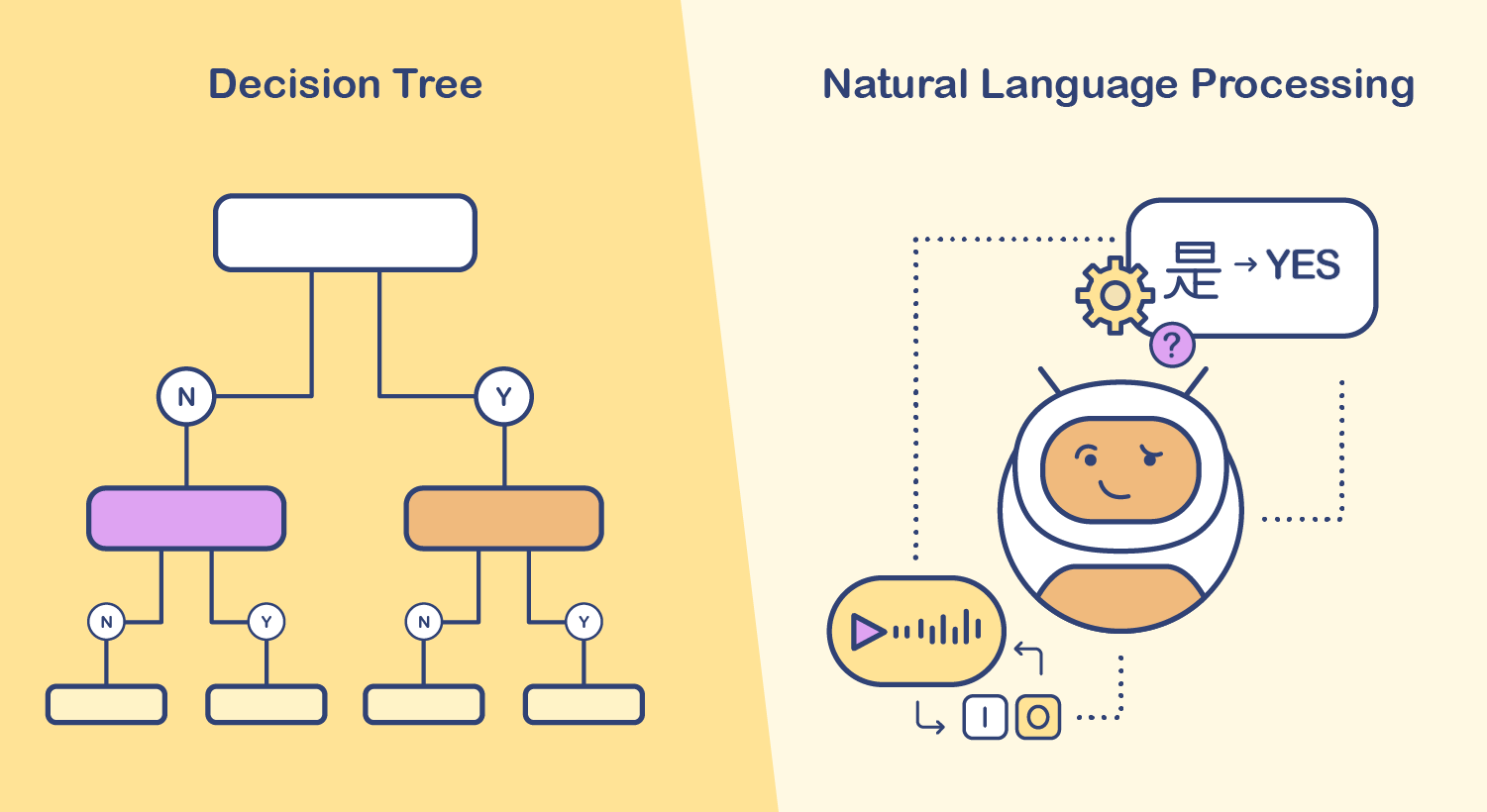
The two dominant architectures behind almost every chatbot on the market work in fundamentally different ways. Decision tree chatbots follow fixed, deterministic rules. NLP based chatbots use probabilistic models to interpret open-ended language. Neither is universally better. Each fits a different shape of conversation.
This guide covers how each type actually works, where each one breaks down, what each costs to build and maintain, and how to decide which one fits your use case, including when the right answer is both.
TL;DR
- Decision tree vs NLP based chatbots comparisons help you pick the right automation model before you build, not after a bot fails in production.
- Decision tree chatbots run on deterministic if-then rules, while NLP chatbots run on probabilistic models that interpret intent.
- Decision tree bots are faster and cheaper to set up, while NLP bots take longer and cost more but handle open-ended input.
- Decision tree bots fail hard outside their scripted paths, while NLP bots can misread intent instead of failing outright.
- Most production systems today combine both: NLP for open questions, decision tree logic for the transactional steps that follow.
- The right choice depends on whether the task is linear, like FAQs and data collection, or open-ended, like complex support conversations.
What Is a Decision Tree Chatbot?
A decision tree chatbot is a rule-based system that guides users through preset conversation paths using if-then logic, not language understanding.
It presents a fixed set of options, usually buttons or a menu, and each choice leads to the next predetermined step. Nothing about the underlying logic changes based on how a person phrases a request. The bot only recognizes what it was explicitly built to recognize. Some teams call this a rule-based bot or a script-based bot instead, but the underlying mechanism is the same tree structure either way.
How Decision Tree Logic Actually Works
Every branch is a human-authored rule: if the user clicks A, show response A. There is no interpretation layer between the click and the reply. This is why chatbot flows built on decision-tree logic are mapped visually before they are ever built, the entire structure has to be planned in advance, since nothing gets figured out at runtime.
The tradeoff for that predictability is coverage. A tree with 20 branches only ever answers the 20 scenarios someone thought to map. Anything the designer did not anticipate simply is not there, regardless of how reasonable the question actually was.
What Is an NLP Based Chatbot?
An NLP based chatbot is a probabilistic system that uses natural language processing and machine learning to interpret free-form text or voice and identify what the user actually wants.
Instead of matching a click to a rule, it translates a sentence into something closer to a mathematical representation, then matches that against trained data to generate a response. The user does not need to know the “right” phrasing. The bot does the work of figuring out the intent. This is also the technology most people mean when they say “conversational AI” or “AI chatbot,” even though NLP is only one layer of what makes that possible.
How NLP Chatbots Interpret Intent and Entities
Two things happen during processing. The system identifies the intent, what the user is trying to do, and pulls out entities, the specific details like a date, an order number, or a product name.
An NLP chatbot needs training data to get both of these right consistently, which is the main reason it takes longer to launch than a decision tree.
The quality of that training data matters more than the amount of it. A model trained on a few hundred well-labeled real customer questions usually outperforms one trained on thousands of generic, unlabeled examples, since intent recognition depends on seeing the actual phrasing patterns a specific customer base uses.
Decision Tree vs NLP Based Chatbots: What’s the Core Difference?
The core difference is architecture: decision tree chatbots follow deterministic scripts, while NLP chatbots use probabilistic language models to understand open-ended input.
| Feature | Decision Tree Chatbot | NLP Based Chatbot |
| Core technology | Rule-based logic, conditional branching | Natural language processing, machine learning |
| Underlying model | Deterministic, the same input always produces the same output | Probabilistic, output depends on trained data and a confidence score |
| User input | Buttons, menus, exact keywords | Free-form text or voice |
| Flexibility | Rigid, fails outside preset paths | High, handles typos, slang, and phrasing variety |
| Handling unfamiliar input | Returns an error or a dead end | Attempts to infer intent, occasionally misreads it |
| Context retention | None, resets at the start of every session | Tracks intent and entities across multiple turns |
| Setup speed | Fast, a flowchart can be mapped in days | Slower, training data takes weeks to collect and label |
| Setup cost | Low upfront investment | Higher upfront investment |
| Ongoing maintenance | Manual update required for every new path | Periodic retraining as customer phrasing drifts |
| Risk profile | Predictable, structurally cannot hallucinate | Can occasionally hallucinate or misjudge intent |
| Best used for | Linear workflows: FAQs, data collection, routing | Dynamic, multi-turn conversations |
Two rows in that table tend to get overlooked in shorter comparisons. Context retention is the difference between a bot that remembers what a customer said two messages ago and one that treats every message as a brand new conversation. Risk profile matters just as much: a decision tree can be frustratingly rigid, but it will never confidently state something false, while an NLP model occasionally will.
How Do Decision Tree Chatbots Handle Unfamiliar Input?
Decision tree chatbots handle unfamiliar input poorly, since anything outside a scripted path triggers an error message or a dead end instead of a real answer.
There is no fallback reasoning. If a user types a question the tree was never built to handle, the bot cannot infer what they meant, it can only report that it does not understand. Every session also resets to the same starting branch, so the bot retains no memory of anything said earlier in the conversation. Several of the most common reasons chatbots fail trace directly back to this rigidity, not to bad intentions in the design.
The visible symptom is usually an error loop: the bot repeats the same fallback message regardless of how the user rephrases the question, because rephrasing does not change which branch the input matches against. A frustrated customer typing the same request three different ways is a strong sign the bot has hit the edge of its tree.
How Do NLP Chatbots Handle Context and Intent?
NLP chatbots handle context by tracking intent and entities across multiple turns of a conversation, instead of resetting after every message.
If a user mentions a flight date early in a conversation, then later asks to change the seat, the bot can carry that date forward without being told again. This is what makes an NLP bot feel conversational rather than transactional.
The Hallucination Tradeoff
That flexibility comes with a real cost. A probabilistic model can misjudge intent or generate a response that sounds confident but is not accurate, something a decision tree structurally cannot do, since a decision tree only ever says what a human explicitly wrote for that exact path. Predictability and flexibility trade off against each other directly here.
Most teams manage this tradeoff with a confidence threshold. If the model’s confidence in its interpretation falls below a set level, the bot asks a clarifying question or hands off to a human instead of guessing. That single design choice determines whether an NLP bot’s mistakes are quiet and rare or frequent and visible to customers.
Which One Costs Less to Set Up and Maintain?
Decision tree chatbots cost less upfront and take less time to launch, while NLP chatbots need training data and ongoing tuning that raise both cost and timeline.
Setup Cost
A decision tree only requires mapping the conversation as a flowchart, a task that can be finished in days. An NLP chatbot requires collecting and labeling sample questions before the model can reliably match intent, which routinely takes weeks.
Maintenance Cost
A decision tree needs a manual update every time a new path is added. An NLP chatbot needs periodic retraining as customer phrasing drifts, product terminology changes, or the model starts missing intents it used to catch.
Consider two teams each launching a bot for order status questions. One maps 15 button paths in a week and launches with no data science work involved. The other spends a month collecting sample questions, tagging intents, and testing edge cases before going live. Both bots may answer the same order status question equally well once launched, but only one needed a month of preparation to get there.
The maintenance gap widens over time in the opposite direction. Every new product, policy, or promotion means someone has to add a new branch to the decision tree by hand, and forgetting one creates a permanent gap the bot cannot bridge on its own. An NLP model absorbs some of that drift automatically, since it is matching against intent rather than an exact predefined path, but it still needs periodic retraining once phrasing shifts enough or a new topic appears often enough to matter.
Pro Tip: Estimate cost by counting how many distinct paths the task actually has. A task with fewer than 10 realistic paths rarely justifies the training overhead of NLP. A task with unpredictable, open-ended input rarely survives long as a decision tree.
What Are the Best Use Cases for Each Chatbot Type?
Decision tree chatbots fit linear, predictable tasks, while NLP chatbots fit open-ended conversations where the same question gets phrased many different ways.
When a Decision Tree Chatbot Fits Best
A software company’s internal IT help desk uses a decision tree bot to route password reset requests: click “Reset Password,” verify identity, receive a reset link. There are only ever three or four realistic paths, so a script covers all of them without gaps. The same logic fits appointment scheduling, simple order tracking, and any workflow where the questions asked have not meaningfully changed in years.
When an NLP Chatbot Fits Best
A mid-size retailer’s support team uses an NLP bot for order questions, since customers phrase the same request a dozen different ways: where’s my package, track my order, did my order ship yet. A fixed button menu cannot anticipate every phrasing, but an NLP bot can match the intent regardless of the exact words used. The same logic fits any support queue where customers describe the same underlying problem in inconsistent, unpredictable language, technical troubleshooting and billing disputes being two common examples.
What Is a Hybrid Chatbot Architecture?
A hybrid chatbot architecture uses NLP to understand a user’s opening question, then switches to decision tree logic to complete the specific transaction that follows.
This is the shape most production systems eventually take. NLP handles the unpredictable part, understanding what the person actually wants from an open-ended first message. Decision tree logic then handles the predictable part, walking through a fixed sequence of steps to actually resolve it. Neither model has to do the job it is weakest at.
This split is also why most chatbot terminology now treats “hybrid” as its own category rather than a compromise between the other two.
A returns process is a common example. The opening message, “I want to return something,” could be phrased a hundred different ways, which is exactly what NLP is built for. Once the intent is confirmed, the actual return, picking a reason code, confirming an order number, generating a label, is a fixed sequence that a decision tree handles more reliably and far more cheaply than asking a language model to hold the whole process in its context window.
How Do You Decide Which Chatbot Type to Build?
Deciding which chatbot type to build comes down to counting how many realistic conversation paths your use case actually has, and how much that number can grow.
A Simple Decision Framework
- List every distinct question or task the bot needs to handle.
- Count how many realistic paths follow from each one.
- Build a decision tree if that count stays under roughly 10 to 15 and rarely changes.
- Build on NLP instead if the count is unpredictable or grows with how customers phrase things.
- Build a hybrid flow if the task has an open-ended start but a predictable finish, rather than forcing one model to do both jobs.
Signs You Need to Switch Types
A decision tree generating frequent dead ends or escalations is a signal to add an NLP layer at the front. An NLP bot spending expensive model calls on repetitive, simple tasks is a signal that a decision tree layer would resolve them faster and cheaper. A support team fielding the same three questions in a hundred different phrasings every week is usually over-served by a pure decision tree and under-served by treating every one of those questions as if it needed full language understanding.
Reviewing the features that actually drive chatbot performance is a useful gut check before committing fully to either direction.
Pro Tip: Revisit this decision every time conversation volume roughly doubles. A chatbot architecture built for 200 conversations a month can outgrow its design by the time it handles 2,000.
Where Should You Start Evaluating Your Options?
Start by mapping the conversations your team already handles manually, then check whether they follow a predictable script or vary too much for one.
Pull the last 50 support conversations and sort them into two piles: ones that followed a fixed, repeatable sequence, and ones that varied every time based on how the customer phrased the request. That ratio tells you more about which architecture fits than any vendor comparison chart. A team that is mostly fixed-sequence conversations should start with a decision tree. A team full of unpredictable phrasing should start with NLP, or plan for a hybrid from day one.
Whichever direction that exercise points to, treat it as a starting architecture rather than a permanent one. The comparison table earlier in this guide is a snapshot of tradeoffs, not a rulebook, and most support operations end up somewhere on the hybrid spectrum within a year of launch regardless of where they started.
If you want to see how this kind of chatbot decision-making works in practice, you can explore the HappyFox Chatbot or get a demo.
Frequently Asked Questions
What is a decision tree chatbot?
Decision tree chatbots follow preset if-then rules, guiding users through buttons and menus instead of interpreting free-form language.
What is an NLP based chatbot?
NLP based chatbots use natural language processing and machine learning to interpret free-form text or voice and identify user intent.
What is the difference between decision tree and NLP chatbots?
Compare architecture first: decision tree bots follow fixed scripts, while NLP bots interpret open-ended language using trained models.
Can you combine a decision tree and an NLP chatbot?
Combine both in a hybrid flow: use NLP to understand the opening question, then decision tree logic to complete the transaction.
Which chatbot type costs less to build?
Choose a decision tree chatbot for lower upfront cost, since it skips the training data and tuning an NLP chatbot requires.
What is the difference between NLP and NLU in chatbots?
Treat NLU as a subset of NLP: NLU focuses specifically on extracting intent and entities, while NLP covers language processing broadly.