Chatbots are revolutionizing the way companies provide customer support to the audience. Companies are undergoing digital transformation at an exponential rate and chatbots are disrupting the industry. Even the simplest chatbot can help you achieve greater customer satisfaction and provide your consumer base with swift resolutions. Different types of chatbots cater to different use cases, here are some of the most obvious and best ways chatbots can come in handy.

While a chatbot can add value to your organization as a standalone automated service, chatbots more often support a live agent customer experience team. Customer service agents no longer have to engage in repetitive conversations with customers. With chatbots, organizations can streamline their business processes and provide world-class uninterrupted customer service through powerful automation.

Types of Chatbots
Chatbots can help companies set off on a path to success with greater customer engagement and efficiency at an affordable price. Here are three main types of chatbots-
- Decision Tree-Based Chatbots or Rule-Based Chatbots
- Natural Language Processing-Based Chatbots or AI Chatbots
- Hybrid Chatbots
Decision Tree-Based Chatbots
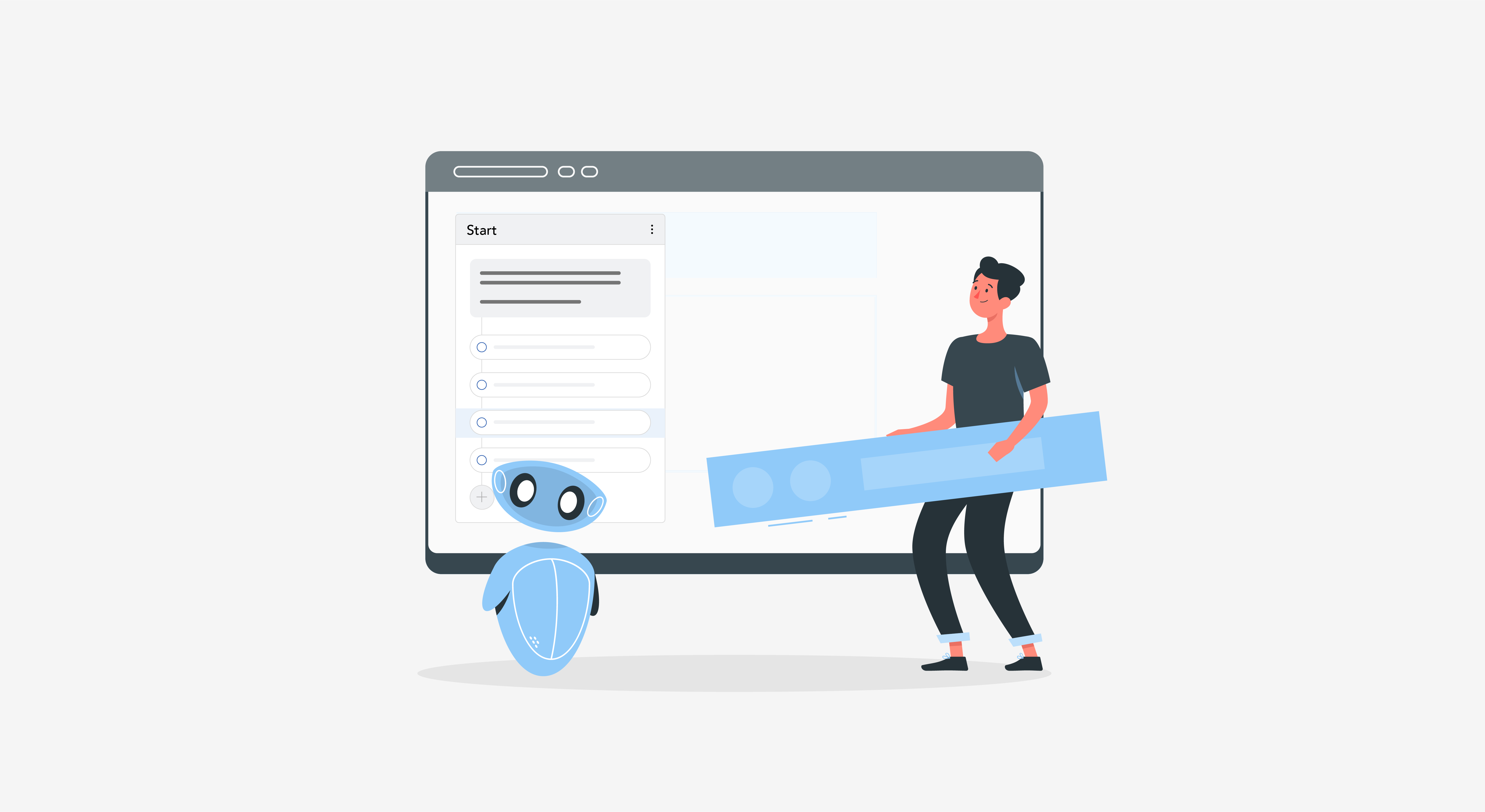
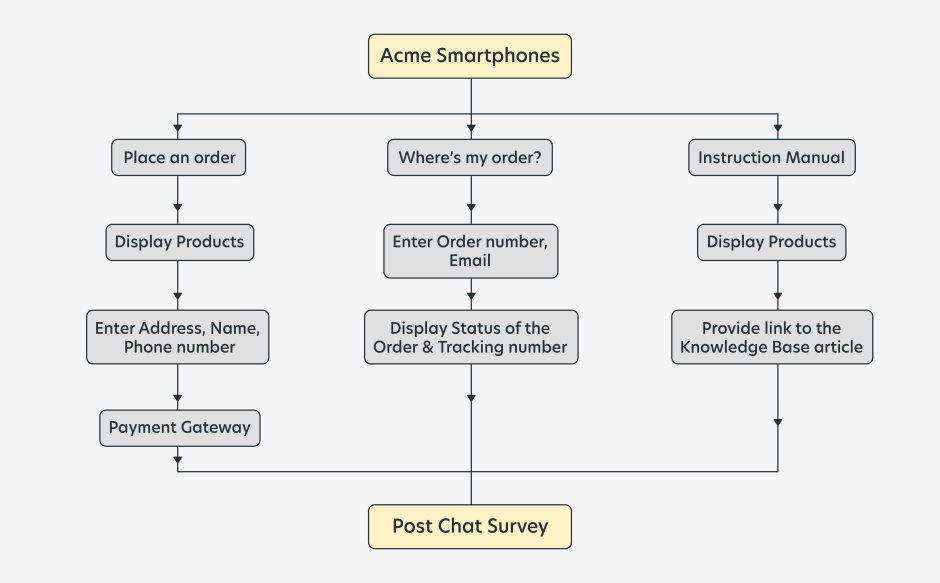
Decision Tree-Based Chatbots or Rule-Based Chatbots are chatbots that use a series of defined rules, “if X then Y” concept to map out conversations. These chatbots drive engagement by anticipating what a customer might ask, and how the chatbot messaging should respond using menu/buttons. These chatbots work by giving you a quick answer in real-time, retrieving results from third-party systems using APIs, navigating you to a knowledge base article, or even human transfer.
The first step is to understand the organization’s Frequently Asked Questions (FAQs) when creating such bots. These scripted chatbots involve a deep analysis of their customers’ queries, designing a bot such that these questions are easily accessible. One of the reasons this type of chatbot has found popularity is that it can support simple and complex flows. This chatbot however does not support queries outside of these ‘rules’.
Advantages of Decision Tree Chatbots:
- Quick to set up
- Less expensive to implement
- Streamlined human agent transfer
- Easy to troubleshoot and make alterations for improved functionality
Example
Let’s say you have a website that offers its visitors the ability to buy smartphones, check the order status of the order placed, and find instruction manuals. In this case, the customer wants to check its order status. The steps are logical and the bot drives this conversation by requiring the user to input their order details. This type of bot would return the tracking number and status of the order.
Natural Language Processing-Based Chatbots
The more sophisticated cousin of the Decision Tree Chatbots, an NLP Chatbot or AI-Based Chatbot is a powerful tool that understands the context of the user input to give relevant answers. The goal of the AI bot chatbot is to simulate a near-human user experience with customers. These chatbots allow users to have a free-flowing conversation without too many clicks.
Powered by machine learning algorithms and artificial intelligence, this contextual chatbot is continuously learning. The more visitors engage with this type of chatbot, the more relevant are the responses.

Advantages of NLP-based Chatbots:
- Continuously improves as more data comes in
- Offers a wider range of support
- Greater scalability
- Easier to maintain without too much human intervention
Example
Your company generates a lot of data and your customers ask you questions ranging from password resets to renewing subscriptions. With an NLP-based support chatbot, the customers search for queries themselves and the chatbots answer questions using pattern recognition.
Hybrid Chatbots
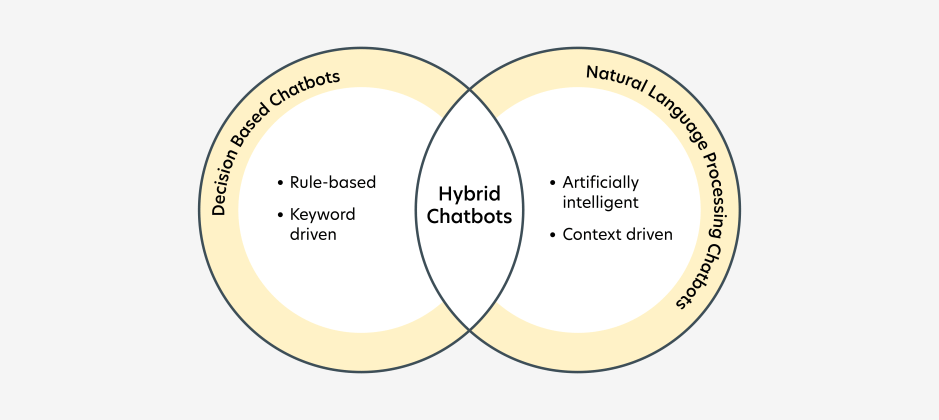
Hybrid chatbots are the perfect amalgamation of NLP and Decision Tree-Based chatbots. These chatbots meet in the middle providing users with the necessary direction as well as the flexibility to search for their questions if they don’t find what they’re looking for explicitly. In addition to this, this chatbot can provide artificial intelligence capabilities and the intellectual capabilities of a human if need be. This balanced approach makes it an industry favorite allowing customers to interact with businesses with easier accessibility.
Example
Your airline company has recently undergone a digital transformation and wants to give its users the ability to seek help about ticket reservations, flight status, refunds, etc using Chatbot technology. You’re trying to deflect some of the incoming customer support tickets from live agents to a virtual assistant, ‘Sandra’. Using a hybrid chatbot, you can give your customers direct resolution to frequently asked questions and also the ability to search questions in an unstructured manner.
Key Takeaways
Chatbots can definitely empower your customer service teams. Today, companies across multiple domains – e-commerce, healthcare, BFSI, etc. are tapping the potential of chatbots. But choosing one of the three customer service chatbot types for your organization can be tricky. If you’re looking for a simple chatbot and can predict the types of questions your customers might ask, a Decision Tree-based chatbot might be the one for you. But if you have a wider range of questions that your customers ask you, you might want to consider the NLP-based Chatbot. Using artificial intelligence, the chatbot serves appropriate responses to the user.
Between the three, Hybrid chatbots are quite popular. With the option of keyword recognition-based and conversational flow, these chatbots offer the simplicity of a Decision Tree chatbot and the complexity of an AI-powered bot. If you’re on the lookout for a powerful tool to compliment your customer service teams, speak to one of your product specialists to know how HappyFox ChatBots can add value to your organization.
FAQ’s
Q1: What are the three main types of chatbots?
A: The three main types of chatbots are Decision Tree-Based Chatbots (also called Rule-Based Chatbots), Natural Language Processing-Based Chatbots (AI Chatbots), and Hybrid Chatbots. Decision Tree chatbots use predefined rules and menu-based interactions, NLP chatbots understand context through artificial intelligence and machine learning, while Hybrid chatbots combine both approaches for maximum flexibility.
Q2: What are Decision Tree-Based Chatbots and when should you use them?
A: Decision Tree-Based or Rule-Based Chatbots use a series of defined rules following an ‘if X then Y’ concept to map conversations. They work through menu buttons and anticipated customer questions. These chatbots are ideal if you can predict the types of questions customers might ask and need quick, streamlined responses. They’re quick to set up, less expensive to implement, and easy to troubleshoot, making them perfect for handling FAQs and simple, structured interactions.
Q3: How do Natural Language Processing-Based Chatbots work?
A: NLP or AI-Based Chatbots are sophisticated tools powered by machine learning algorithms and artificial intelligence that understand the context of user inputs. They enable free-flowing conversations without rigid menu structures and continuously learn from interactions. The more visitors engage with them, the more accurate their responses become. These chatbots are ideal for businesses with a wider range of customer questions and those seeking greater scalability with minimal human intervention.
Q4: What are Hybrid Chatbots and why are they popular?
A: Hybrid Chatbots combine the best features of both Decision Tree and NLP chatbots. They provide users with structured menu-based navigation while also offering the flexibility to search for questions in an unstructured manner using AI. This balanced approach makes them industry favorites because they offer the simplicity and quick setup of rule-based bots along with the intelligence and adaptability of AI-powered bots, providing easier accessibility for customers.
Q5: What are the main advantages of Decision Tree Chatbots?
A: Decision Tree Chatbots offer several key advantages including quick setup time, lower implementation costs compared to AI chatbots, streamlined transfer to human agents when needed, and ease of troubleshooting and making alterations for improved functionality. However, they are limited to handling only queries that fall within their predefined rules and cannot understand queries outside these parameters.
Q6: What are the benefits of using NLP-based Chatbots?
A: NLP-based Chatbots provide multiple benefits including continuous improvement as more data is collected, ability to offer a wider range of support beyond scripted responses, greater scalability to handle complex and varied queries, and easier maintenance without requiring excessive human intervention. These chatbots use pattern recognition to understand diverse customer questions and can handle everything from password resets to subscription renewals.
Q7: How do chatbots improve customer service operations?
A: Chatbots improve customer service by automating repetitive tasks, allowing customer service agents to focus on more complex issues. They streamline business processes, provide uninterrupted 24/7 service, deliver swift resolutions, and help achieve greater customer satisfaction. Chatbots can handle multiple use cases including answering FAQs, checking order status, providing product information, routing tickets, and transferring to human agents when necessary.
Q8: Which chatbot type should I choose for my business?
A: The choice depends on your specific needs. Choose Decision Tree chatbots if you can predict customer questions and need a simple, cost-effective solution for structured interactions. Opt for NLP-based chatbots if customers ask a wide range of unpredictable questions and you need advanced AI capabilities. Consider Hybrid chatbots for the best of both worlds—they’re the most popular choice as they combine structured navigation with AI flexibility, making them suitable for most businesses undergoing digital transformation.