Chatbots are gaining a lot of popularity across industries. But companies are often left wondering which approach to building a chatbot would truly benefit them – Decision Tree or AI Chatbots aka Natural Language Processing (NLP) based Chatbots.
Should you choose a Decision Tree (rule-based) chatbot or an NLP (AI-powered) chatbot?
In this guide, we’ll break down:
- What Decision Tree and NLP chatbots are
- Key differences between them
- Real-world use cases
- Which chatbot type is better for your business needs
If you’re evaluating chatbot options for the first time, this comparison will help you make a confident choice.
What is a Decision-Tree Based Chatbot?
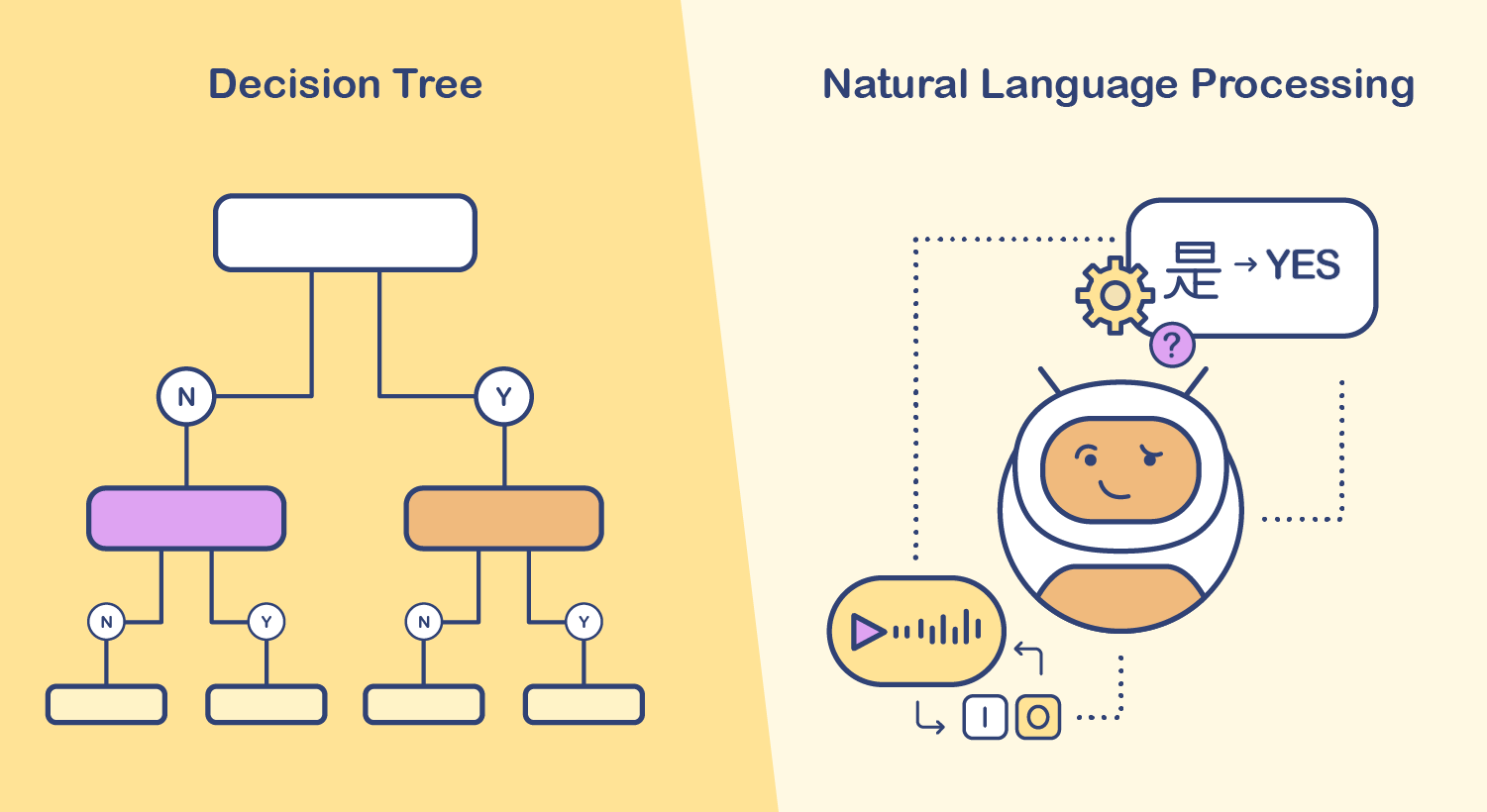
Decision-Tree Based Chatbots, also known as “Rule-Based” chatbots are a very popular type of chatbot. These particularly use a series of pre-defined rules to drive visitor conversation offering them a conditional if/then at each step. Decision trees can also replace general FAQs.
Decision trees offer visitors accurate and pointed answers to their queries and require a thorough analysis of historical customer service queries and data. Once the frequently asked questions are determined, rule-based chatbots slowly narrow each conversation until the visitor is happy with their answer. Sometimes the bots also navigate them to a Live agent if the person on the other side is not happy with the answer.
For example, if a customer is looking for a user manual for upgrading their software, they’d choose the “user manual” button where they’d be asked for the product type, model number, etc. Of course, this is a highly customizable model, making it a very widely used platform.
Advantages of Decision-Tree Based Chatbot
Some of the reasons why this type of chatbot is popular in the industry are:
- The conversation flow is highly customizable
- The analysis and setup is easy, making it quick to setup
- The handover to a human agent is straightforward
- Give pointed and more accurate answers with higher customer satisfaction
What is a Natural Language Processing Based Chatbot?
Natural Language Processing (NLP) based chatbots or simply put – “AI-powered Chatbots” are a powerful variety of chatbots that use machine learning to understand the context of unstructured inputs from the visitor. The bot in this case provides them with a response through pattern interpretation rather than fixed buttons and a flow. To understand the input, these types of questions do not look for keywords but instead dissect the phrases into detecting “intents” – the motive of a visitor. For example, while one might type “Get Pizza”, someone else might input “I am hungry”; in both cases, the bot must provide a way for the user to order a pizza.
NLP backed chatbots require training. Training refers to the process of educating the chatbot on how to guess the most appropriate response to the user’s spoken or typed input. Essentially, the more you train your bot, the more they learn, and the more accurate they get in providing resolution to your customers.
Advantages of NLP Based Chatbot
Some of the reasons AI powered chatbots have been gaining popularity in the industry are:
- They save significant time and money in the long run due to their self-learning
- They are better suited for complex support requests and addressing open-ended questions
- They make a strong case for sentiment analysis
- They are resource-efficient reducing the human intervention in maintenance, training, etc
- They help improve customer experience through natural conversations
Why a Hybrid Chatbot Approach Works Best
People often wonder which of the two is better. There are advantages and disadvantages to each. For instance, while the initial setup of a Rule-based bot is a lot easier and quicker, it gets a lot more tricker with complex logic. For an NLP based chatbot, the initial setup can be a long process but once the required time and effort is put in, it doesn’t need a lot of manual work as it learns from real-time user conversations. Another way to think about it is that by implementing a rule-based bot, you are providing buttons and a clear pathway for the customers to find relevant information while AI gives the users the flexibility to ask anything!

While it basically boils down to the business needs and the model of an organization and it’s customer base, the most successful and smart way to implement a chatbot is to start with a decision-tree based chatbot and then layering in conversational AI chatbots. While NLP seems intimidating at first, it largely depends on the platform you use. When using an intuitive system like HappyFox Chatbot, implementation is simplified helping you get up and running quickly.