Customer service and customer experience are often used interchangeably. However they are not the same. One handles individual interactions. The other shapes the entire relationship.
If businesses misunderstand the difference, they allocate resources incorrectly and measure the wrong outcomes. This guide breaks down the difference between them across ownership, scope, metrics, and business impact so you can align strategy properly.
What is Customer Service?
Customer service refers to the direct assistance provided during specific customer interactions. It includes answering questions, resolving complaints, processing returns, and offering support during or after a purchase.
The focus is transactional. Customer service teams focus not just on responding to issues but also actively making the first move to help customers to eliminate problems. The objective is to solve the immediate issue efficiently while maintaining customer satisfaction. Customer service teams are primarily responsible for metrics such as response time, resolution time, SLA adherence, and customer satisfaction scores.
Customer service is the direct assistance a business provides during specific customer interactions. It includes answering questions, resolving complaints, processing returns, and offering support before or after a purchase to ensure issues are handled efficiently and satisfaction is maintained.
Some examples of great customer service are:
- Personalized and relevant communication
- Live Chat and Chatbot Support
- Social Media Support on Facebook, Twitter
- Prompt Responses
When to Prioritize Customer Service
While both functions are important, there are specific situations where strengthening customer service should take priority. These signals usually appear in day to day operations and direct support interactions.
Operational inefficiencies:
If response times are increasing or SLAs are being missed, the issue is at the service level. Delays in resolving problems directly affect customer satisfaction. Strengthening customer service improves immediate stability.
High ticket volume:
When support teams are overwhelmed with repetitive or unresolved tickets, service execution needs attention. Optimizing workflows and resolution processes reduces friction in customer interactions.
Declining CSAT scores:
If customers express dissatisfaction after support interactions, the weakness lies in service delivery. Improving training, responsiveness, and clarity becomes essential.
Frequent issue escalation:
When simple problems consistently escalate, support processes are likely inefficient. Prioritizing customer service ensures faster resolution and restores trust in real time.
What is Customer Experience?
Customer experience represents the complete perception a customer forms about a brand across all touchpoints. It includes marketing communication, product usability, onboarding, support interactions, and post purchase engagement.
Customer Experience is a joint, cross-functional effort. This means the onus of providing a seamless experience falls on a lot of shoulders – Sales, Services, and Support. CX is also a proactive and long term effort and aims to foster a long-lasting and mutually beneficial relationship rather than fixing an immediate issue.
Customer Experience teams must possess problem-solving skills in addition to being data-driven and strategic. The ability to build and maintain relationships with external stakeholders and internal cross-functional team members is also essential.
Some examples of great customer experience are:
- Social listening – utilizing Facebook, Twitter to engage with customers
- Utilizing Surveys and feedback for continuous improvement
- Create an emotional connection with customers by going the extra mile – fast shipping, easy return policy, ease of completing purchases, and tracking order.
When to Prioritize Customer Experience
Customer experience should be prioritized when challenges extend beyond individual support interactions and begin affecting overall perception. These signals usually appear in loyalty trends, retention data, and cross functional inconsistencies.
Rising churn rate:
If customers stop renewing or repeat purchases decline despite stable service performance, the issue is broader than support. This indicates gaps in the overall journey that require strategic alignment.
Journey level friction:
When customers struggle during onboarding, billing, product usage, or communication, the experience feels disjointed. Improving coordination across teams becomes necessary.
Weak loyalty indicators:
Declining Net Promoter Score or retention rates signal that customers do not feel long term value. Experience improvements focus on strengthening emotional connection and consistency.
Scaling inconsistencies:
As the business grows, disconnected systems and mixed messaging can create confusion. Prioritizing customer experience ensures alignment across departments and touchpoints.
Customer Service Vs. Customer Experience
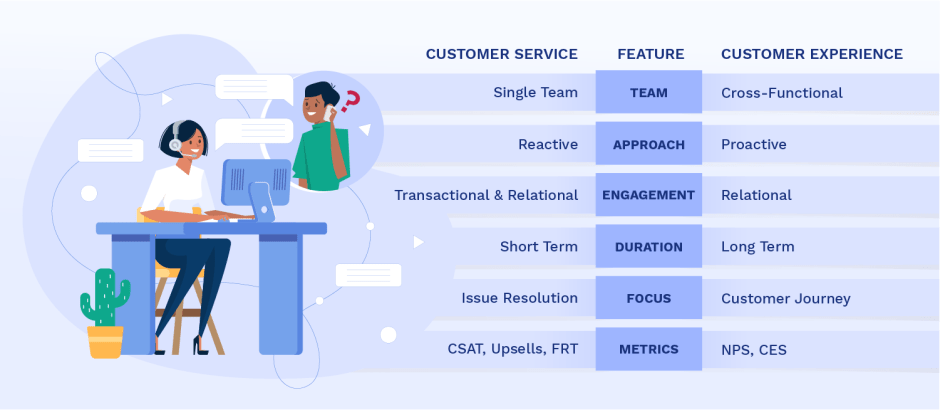
Customer service is one part of the overall customer journey, while customer experience covers every interaction a customer has with your brand. Although the two are closely connected, they differ clearly in scope, ownership, timing, and measurement.
| Area | Customer Service | Customer Experience |
| Scope | Focuses on individual interactions and issue resolution | Covers the entire customer journey across all touchpoints |
| Proactive vs Reactive | Primarily reactive, responds to problems after they occur | Primarily proactive, designs journeys to prevent issues |
| Ownership | Owned by support or service teams | Shared across product, marketing, sales, and support |
| Timing | Triggered during a specific need or complaint, often post purchase | Begins at awareness and continues through retention |
| Metrics | CSAT, First Response Time, Resolution Time, SLA adherence | NPS, Customer Effort Score, retention, lifetime value |
Scope:
Customer service focuses on direct interactions between a customer and the support team. It deals with questions, complaints, troubleshooting, and transactional support.
Customer experience covers the full lifecycle of the customer relationship. It includes marketing communication, product usability, onboarding, service interactions, and post purchase engagement.
Proactive vs Reactive:
Customer service is generally reactive. It responds when a customer raises an issue or requires assistance.
Customer experience is proactive. It aims to design systems and processes that reduce friction and prevent dissatisfaction before problems arise.
Ownership:
Customer service is primarily the responsibility of customer support managers and service agents. While other teams may interact with customers, the support function is accountable for resolving issues effectively.
Customer experience is a shared responsibility across the organization. Marketing shapes expectations, sales manages early interactions, product influences usability, and support reinforces the relationship. Every team contributes to the overall perception.
Timing:
Customer service is triggered by a specific need, often during or after a purchase. It focuses on resolving the issue at hand within that moment.
Customer experience begins before the first transaction. It spans awareness, consideration, purchase, onboarding, support, and long term retention.
Metrics:
Customer service is measured using interaction level indicators such as Customer Satisfaction Score, Customer Effort Score, response time, and resolution speed. These metrics assess how efficiently issues are handled.
Customer experience is measured using broader business indicators such as Net Promoter Score, customer lifetime value, churn rate, and retention rate. These metrics reflect loyalty and long term relationship strength.
Conclusion
According to PWC, 42% of consumers worldwide would pay more for a friendly, welcoming experience, touting a positive experience with a brand to be more influential than great advertising. Today businesses can not do without expanding their efforts in building exceptional customer experience and customer service. If you’re on the path to exploring how this journey could be made simpler using a powerful suite of products, feel free to reach out to us.
Frequently Asked Questions
1. What is the difference between customer service and customer experience?
Customer service is the support provided during individual interactions-like resolving issues or answering questions. Customer experience is the overall perception a customer forms from every brand touchpoint, including service, product use, communication, and post-purchase engagement.
2. How are customer service and customer experience connected?
Customer service is a key part of customer experience. While experience spans the entire journey, service interactions often define how customers feel about a brand. Consistent, empathetic service enhances overall experience and builds long-term loyalty.
3. Which is more important: customer service or customer experience?
Both are vital. Excellent customer service drives immediate satisfaction, while customer experience ensures sustained trust and retention. Businesses should view service as a building block that shapes and strengthens the broader customer experience strategy.
4. How does customer service impact customer experience?
Customer service directly influences experience by shaping emotional perception and problem resolution. Fast, friendly, and effective support boosts satisfaction and loyalty, while inconsistent or delayed service can damage the overall customer experience.
5. How can businesses improve both customer service and customer experience?
Train agents to deliver empathetic, consistent support and use omnichannel tools for unified interactions. Collect feedback across touchpoints, analyze pain points, and act on insights to ensure each customer interaction contributes to a seamless, positive experience.