Talk about Automation, AI or Machine Learning and you will instantly include bots in your conversation. With the advancement in technology chatbots have become more popular than ever for any kind of online business.
Chatbots are artificial intelligence systems that interact with users via text, messaging, or voice.
They are available to serve their customers 24/7, can speak their language, and meet their customers on different touchpoints (website, mobile apps, social media).
Looking at Google Trends search data we can see that the curiosity on “chatbots for customer service” has been increasing since 2015 and is on a rise in 2021 and the trend will continue to improve in the near future.
Our team at HappyFox has worked hard to build AI chatbots for customers that have led to Year-on-Year(YoY) growth for our clients. We thought it would suit us best to collate all the must-know chatbots statistics every support leader needs to know in 2021.
Find below the list of all up-to-date chatbot statistics below:
Chatbots for Customer Service
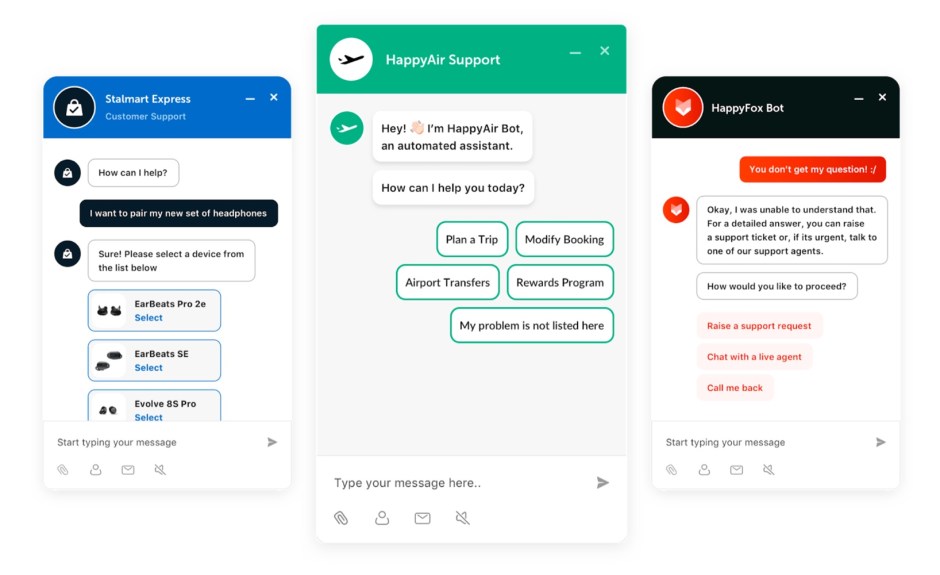
Customers today need instant gratification more than ever before and so customer service and self-service are two in demand and high priority areas for businesses these days. Chatbots can help in providing a great customer experience and also reduce your budget on manual tasks. Based on research with various businesses and customers these are the stats that we can keep in mind while evaluating chatbots for customer service.
- By 2021 consumers will handle 85% of their engagement with businesses without ever interacting with another human being. (Forbes)
- Chatbots can help businesses save up to 30% on their customer support costs (IBM)
- 27% of consumers were unsure if the last customer support interaction they had was with a real person or a chatbot (PwC)
- 34% of retail customers would be comfortable speaking with customer service through AI chatbots instead of a live customer support representative (Statista)
- 64% of businesses believe that chatbots will allow them to provide a more customized support experience for their customers (Statista)
- 25 % of Customer Service Operations Will Use Virtual Assistants by 2021(Gartner)
- B2C companies see 50-66% ticket deflection for Frequently asked questions within 90 days after implementing bot. (HappyFox)
Chatbot Stats by Numbers
Chatbots aren’t just for answering questions, they can also impact sales. On a day to day basis we might not be thinking how chatbots facilitate conversions but these stats might surprise you.
- 57% of executives said that chatbots bring significant ROI with minimal effort. (Accenture)
- AI-derived business is projected to be valued at $3.9 trillion by 2022 (Gartner)
- Retail, banking, and healthcare will realize cost savings of $11 billion annually by 2023, up from an estimated $6 billion in 2018 because of chatbots. (Juniper Research)
- Chatbots are projected to save 2.5 billion hours for businesses and consumers from chatbots by 2023 (Juniper Research)
- 53% of service-providing organizations expect to use chatbots within 18 months — a 136% growth rate from the previous 18 months. (Salesforce)
- By 2021, 80% of enterprises will look to use chatbots (Business Insider)
- Chatbots can help businesses save up to 30% on their customer support costs (IBM)
Chatbots and Conversions
Chatbots are non obstructive and non spammy pieces of technology that can be used for marketing your products or service to customers and improve conversion funnel. In fact, you’ll see in this list of chatbot stats, more and more businesses are using chatbots to help consumers make purchasing decisions.
- A HubSpot survey found that 47% of consumers would be open to making a purchase from a chatbot (HubSpot)
- eCommerce stores adopting Facebook Messenger along with an abandon cart chatbot have started to boost revenue by 7-25% (Chatbots Magazine)
- The top 5 industries profiting from the incorporation of chatbots are real estate (28%), travel (16%), education (14%), healthcare (10%), and finance (5%) (Chatbots Life)
- Millennials are about twice as likely to use a chatbot that acts as a personal shopper compared to age groups older than them (Facebook)
Consumer Preferences with Chatbots
It’s always good to know consumer behavior while using chatbots and to see where we are heading with this piece of technology in the future. Following are stats collected by different agencies, that give a real picture of the advantage and disadvantage of using chatbots.
- Approximately 40% of people of all ages prefer to use chatbots when shopping online.
- 95% of the consumers believe ‘customer service’ is going to be the major beneficiary of Chatbots. (Invesp)
- A study conducted by NewVoiceMedia found that 46% of consumers felt chatbots were being used to prevent them from reaching a live person (NewVoiceMedia)
- 34% of retail customers would be comfortable speaking with customer service through AI chatbots instead of a live customer support representative (Statista)
- 60% of millennials say they have used chatbots. 70% of them say they had a positive experience. (Forbes)
- 60% of consumers believe a human agents can better understand what they need as compared to a chatbot (Business Insider)
- 48% of people care more about a chatbot being able to solve their issues over it having a personality (Business Insider)
- 46% of respondents in a Usabilla survey said they would choose a live person over a chatbot even if engaging with a chatbot saved them 10 minutes
- 60% of consumers aged 35-44 believe companies are too quick to replace human representatives with chatbots (CGS)
- 40% of consumers have no preference when it comes to engaging with a chatbot or a human for help, as long as they receive the support they need (HubSpot)
- 27% of consumers were unsure if the last customer support interaction they had was with a real person or a chatbot (PwC)
- Approximately 1.4 Billion People Use Messaging Apps and are willing to talk to Chatbots. (Business Insider)
Conclusion
Chatbot technology was perceived to be complex earlier but going by the chatbot trends it’s evident that more and more businesses are adopting chatbots and are benefitting from it. The design and architecture of chatbots and chatbot builders is inevitably improving and so it’s becoming accessible to more and more businesses.
Frequently Asked Questions
Q1: How much can businesses save by implementing chatbots?
A: Chatbots can help businesses save up to 30% on their customer support costs. By 2023, retail, banking, and healthcare industries are projected to realize cost savings of $11 billion annually, up from an estimated $6 billion in 2018. Additionally, chatbots are projected to save 2.5 billion hours for businesses and consumers by 2023, demonstrating significant time and resource efficiency.
Q2: What percentage of consumers are comfortable using chatbots for customer service?
A: 34% of retail customers would be comfortable speaking with customer service through AI chatbots instead of live representatives. However, consumer preferences vary: 60% of millennials have used chatbots and 70% report positive experiences, while 40% of all consumers have no preference between chatbots or humans as long as they receive needed support. Notably, 27% of consumers were unsure if their last customer support interaction was with a real person or a chatbot.
Q3: How are chatbots expected to impact business operations by 2021-2023?
A: By 2021, consumers were expected to handle 85% of their engagement with businesses without interacting with another human. Additionally, 80% of enterprises were projected to use chatbots by 2021, with 53% of service-providing organizations expecting to use chatbots within 18 months—representing a 136% growth rate. By 2023, chatbots are projected to save 2.5 billion hours and deliver $11 billion in annual cost savings.
Q4: What ROI do chatbots provide for businesses?
A: 57% of executives report that chatbots bring significant ROI with minimal effort. AI-derived business is projected to be valued at $3.9 trillion by 2022. B2C companies see 50-66% ticket deflection for frequently asked questions within 90 days after implementing chatbots. Businesses can save up to 30% on customer support costs, while 64% believe chatbots allow them to provide more customized support experiences.
Q5: How do chatbots impact sales and conversions?
A: 47% of consumers would be open to making purchases from chatbots according to HubSpot. eCommerce stores adopting Facebook Messenger with abandoned cart chatbots have boosted revenue by 7-25%. The top industries profiting from chatbots are real estate (28%), travel (16%), education (14%), healthcare (10%), and finance (5%). Approximately 40% of people of all ages prefer using chatbots when shopping online.
Q6: What do consumers value most in chatbots?
A: 48% of consumers care more about chatbots solving their issues than having personality. 95% believe customer service is the major beneficiary of chatbots. However, 60% of consumers believe human agents better understand their needs compared to chatbots, and 46% feel chatbots prevent them from reaching live support. Despite this, 40% have no preference between chatbots or humans as long as they receive needed support.
Q7: How quickly do chatbots reduce support tickets?
A: B2C companies experience 50-66% ticket deflection for frequently asked questions within just 90 days after implementing chatbots. This rapid reduction in support tickets allows human agents to focus on more complex issues while chatbots handle routine inquiries efficiently. By 2021, 25% of customer service operations were expected to use virtual assistants for this purpose.
Q8: Which age groups are most receptive to chatbots?
A: Millennials show the highest chatbot adoption, with 60% having used them and 70% reporting positive experiences. They are approximately twice as likely as older age groups to use chatbots acting as personal shoppers. However, 60% of consumers aged 35-44 believe companies are too quick to replace human representatives with chatbots, indicating generational differences in chatbot acceptance.