Every support team wants to respond faster. Every customer expects quick resolution. But without structured targets, speed becomes inconsistent and performance becomes difficult to measure.
That’s where SLA goals come in. SLA goals define how fast your team should respond, how quickly issues should be resolved, and how consistently those targets must be achieved. When properly implemented, SLA goals bring structure, accountability, and measurable improvement to help desk operations.
This guide explains what SLA goals are, how to define them correctly, common examples, best practices, and how to continuously improve SLA performance in your help desk.
What is an SLA
A Service Level Agreement (SLA) is a formal agreement that defines the level of service expected between a provider and a customer.
In a help desk environment, SLAs define:
- How quickly must tickets receive a first response
- How fast should issues be resolved
- Which tickets get priority
- What percentage of tickets must meet these timelines?
An SLA transforms vague expectations, such as “respond quickly,” into measurable commitments.
What are SLA Goals
SLA goals are the measurable performance targets defined within an SLA. They set the benchmark for how quickly and how consistently support services must be delivered.
An SLA goal generally includes:
- A defined metric (e.g., First Response Time)
- A time threshold (e.g., within 1 hour)
- A compliance percentage (e.g., 95 percent of tickets)
For example:
- Respond to critical tickets within 30 minutes
- Resolve high-priority tickets within 8 business hours
- Achieve 95 percent SLA compliance monthly
Without clear SLA goals, performance cannot be objectively evaluated.
SLA Goals vs SLA Metrics
This distinction is important.
SLA metrics are measurable data points such as:
- First Response Time
- Average Resolution Time
- Time to first assignment
- Ticket breach rate
- Uptime percentage
SLA goals define the acceptable limits for those metrics.
For example:
Metric: First Response Time
Goal: Under 60 minutes for high-priority tickets
Metric: Resolution Time
Goal: Within 24 hours for standard tickets
Metrics measure performance.
Goals define acceptable performance.
Why SLA Goals Are Critical for Support Teams
SLA goals are not just administrative controls. They directly influence customer satisfaction and operational stability.
Consider a scenario:
A customer raises a high-priority ticket about a payment system failure. Without structured SLA goals, that ticket may sit behind older, low-impact requests. By the time the issue is addressed, the business has already suffered revenue loss.
With properly defined SLA goals:
- The system flags the urgency
- Escalation triggers automatically
- The ticket receives prioritized attention
Strong SLA goals help teams:
- Prevent critical tickets from being overlooked
- Improve response time consistency
- Reduce customer churn
- Increase CSAT scores
- Maintain accountability across agents
Consistency builds trust more than occasional speed.
Key Objectives of SLA Goals
Well-defined SLA goals serve multiple operational purposes. Each objective plays a role in stabilizing and improving help desk performance.
1. Establish Clear Service Expectations
SLA goals remove ambiguity. Agents know what timelines they must meet. Customers understand when to expect responses. Clear expectations reduce frustration on both sides.
2. Prioritize High-Impact Issues
Not all tickets require the same urgency. SLA goals help differentiate between critical incidents and low-priority requests. This ensures that urgent issues receive immediate attention without overwhelming the team.
3. Improve Operational Accountability
When SLA goals are measurable, breaches become visible. Managers can identify recurring delays, bottlenecks, or workflow inefficiencies and take corrective action.
4. Standardize Performance Across Teams
Without SLA goals, response times vary widely between agents. SLAs create uniform service standards that improve predictability.
5. Enable Continuous Performance Improvement
Tracking SLA compliance highlights patterns. For example:
- Frequent breaches during peak hours
- Delays caused by ticket misrouting
- Resolution slowdowns due to dependency on another department
These insights allow teams to optimize operations over time.
Common Examples of SLA Goals in Help Desks
First Response Time Goals
- Critical priority: 15–30 minutes
- High priority: 1–2 hours
- Medium priority: 4–8 hours
- Low priority: 1 business day
Resolution Time Goals
- Critical: 4–8 business hours
- High: 1 business day
- Medium: 2 business days
- Low: 3–5 business days
SLA Compliance Percentage
This determines how consistently goals must be met.
- 90 percent compliance: Suitable for growing teams
- 95 percent compliance: Industry standard for stable operations
- 98 percent or higher: Requires strong automation and staffing
Selecting an unrealistic compliance target can increase burnout and breach frequency.
Best Practices for Setting Effective SLA Goals
Defining SLA goals requires a balance between ambition and operational capacity.
Align Goals with Actual Team Capacity
Review historical ticket data before defining targets. Consider average ticket volume, staffing levels, and peak periods.
Define Separate SLAs by Priority
Avoid a single timeline for all tickets. High-impact issues require shorter response and resolution windows.
Measure Using Business Hours
Ensure SLA clocks run only during defined working hours unless 24/7 support is offered.
Implement Escalation Before Breach
Set automated alerts at 70 percent or 80 percent of the SLA time limit to allow intervention before deadlines are missed.
Regularly Review and Adjust Goals
As products evolve and ticket volume changes, SLA goals should be reassessed quarterly or bi-annually.
Common Mistakes That Hurt SLA Goal Achievement
- Setting unrealistic timelines without reviewing historical data
- Ignoring resolution time while focusing only on first response
- Failing to differentiate priorities
- Lack of escalation rules
- Not analyzing root causes of repeated breaches
SLA goals should drive performance improvement, not simply generate reports.
How to Set Up SLA Goals in HappyFox Help Desk
HappyFox Help Desk allows teams to configure structured SLA policies based on business workflows.
An SLA in HappyFox includes:
- Objective (what must happen)
- Conditions (which tickets qualify)
- Goal percentage (required compliance rate)
- Work schedule (time tracking window)
Step 1: Define Objectives
Select which metrics to control, such as First Response Time or Resolution Time.
Step 2: Set Conditions
Apply SLAs based on:
- Ticket priority
- Ticket type
- Customer segment
- Assigned group
Step 3: Define Compliance Percentage
Start conservatively and increase as operational maturity improves.
Step 4: Assign Work Schedules
Ensure time calculations reflect business hours accurately.
How does HappyFox Help Desk Manage SLAs?
Once you have decided your SLAs, your support team must manage their time and track them correctly to meet their deadlines. HappyFox Help Desk is equipped to track, automate and report on SLAs. Here’s how HappyFox Help Desk helps you keep up with your SLA obligations for better customer experience :
Tracking
HappyFox Help Desk assigns an SLA to the customer tickets based on the criteria satisfied by the ticket. It also automatically keeps track of the time elapsed by considering business hours.
Notification
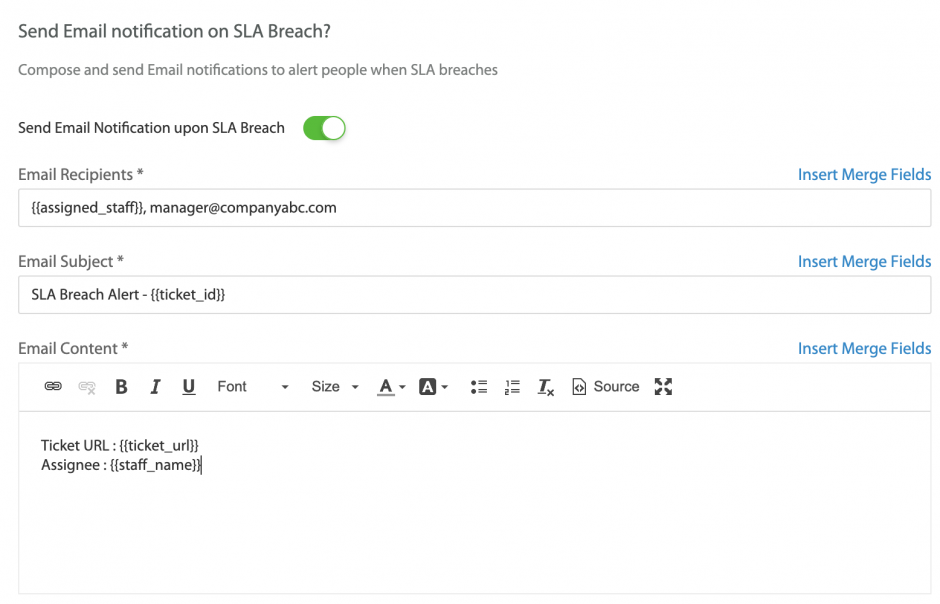
Setting up notifications upon SLA breach is super easy in HappyFox Help Desk. You can notify the owner of the ticket as well as escalate the ticket by marking the manager or supervisor on the notification email.
Queues
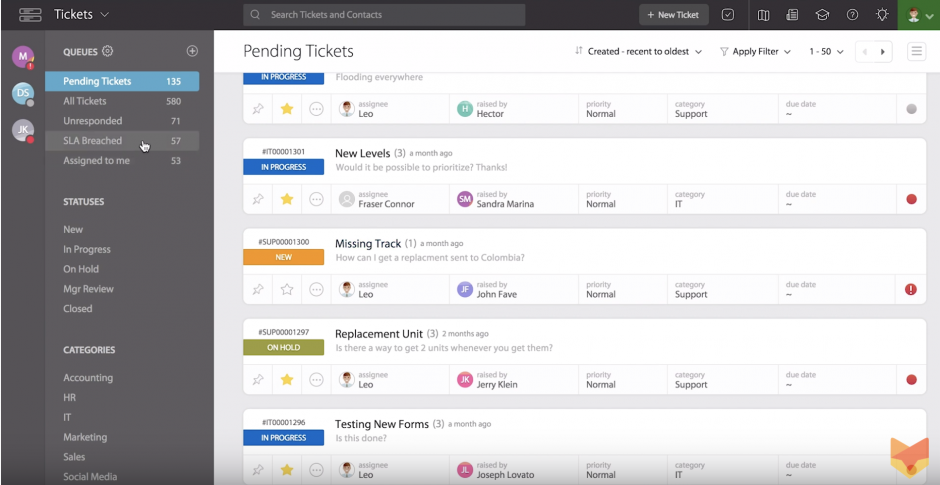
HappyFox Help Desk has a provision to create queues for tickets that breached SLA. Queues make it simple to see all tickets that have breached SLA and apply filters like sort tickets from oldest to newest or vice-versa.
Reports
SLA Management does not end with just creating SLAs. Continuous improvement is necessary, and this requires monitoring.HappyFox provides SLA reports which provide information on the following:
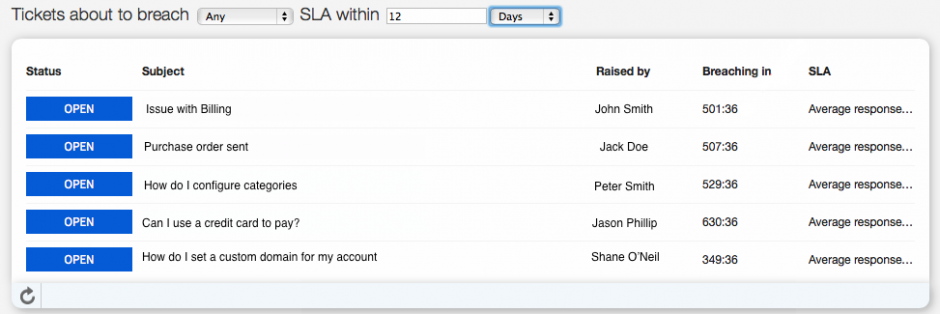
- Tickets about to breach SLA Report: This report as the name suggests, shows a list of tickets that are nearing SLA breach. There is a link to the ticket and also a live timer that shows the time left for the ticket to breach (in minutes).
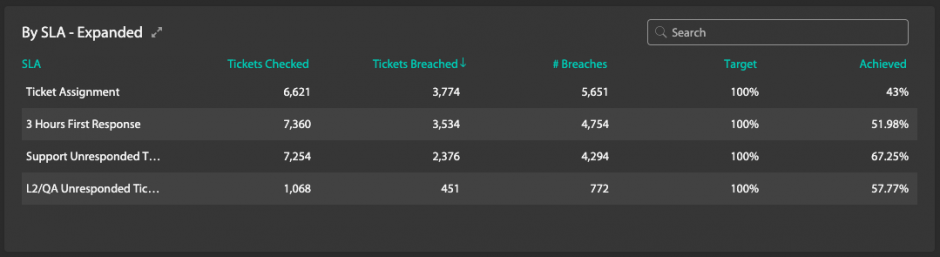
- SLA Target Report: This report lets you monitor your goals on meeting SLAs. For example: If the SLA goal is 95%, then 95 out of every 100 tickets should be responded before the SLA is breached. SLA target reports give us an estimate of where we stand.
Bottomline
SLA goals transform support operations from reactive ticket handling into measurable service delivery.
- Clear goals improve accountability.
- Structured tracking improves consistency.
- Continuous reporting improves results.
By setting realistic SLA goals and monitoring compliance regularly, support teams can improve response speed, reduce escalations, and deliver a stronger customer experience.
HappyFox Help Desk provides the tools to define, monitor, and optimize SLA goals effectively.
FAQ
What are SLA goals in a help desk?
SLA goals are defined performance targets within a Service Level Agreement that specify how quickly tickets must be responded to or resolved and the percentage of tickets that must meet those timelines.
What is a good SLA compliance percentage?
Most help desks aim for 90 to 95 percent SLA compliance. Mature teams with strong automation may target 98 percent or higher.
How do you calculate SLA goal percentage?
SLA compliance percentage is calculated by dividing the number of tickets that met the SLA by the total number of applicable tickets, then multiplying by 100.
What is the difference between SLA goals and KPIs?
SLA goals are specific contractual performance targets tied to time thresholds. KPIs are broader performance indicators that measure overall operational effectiveness.
How often should SLA goals be reviewed?
SLA goals should be reviewed quarterly or whenever significant changes occur in ticket volume, staffing, or service structure.